You can spend months chasing contract opportunities, respond to every RFP you see, and still watch awards go to someone else. Not because your products or services aren’t good—but because your proposal effort is inconsistent, reactive, and hard to scale.
That’s why proposal systems are the secret weapon for winning more contracts: they turn scattered heroics into a repeatable process. If you’re serious about winning more government contracts, the secret to winning more government work isn’t “submitting the most proposals”—it’s building a machine that produces proposal success on demand, across government proposals, with fewer fire drills and better win rates.
Why proposal systems are the secret weapon for government contractors chasing contract opportunities
Most government contractors don’t lose on capability. They lose on execution: missed details, rushed writing, inconsistent pricing logic, and “we’ll fix it in the final review” chaos that never really gets fixed.
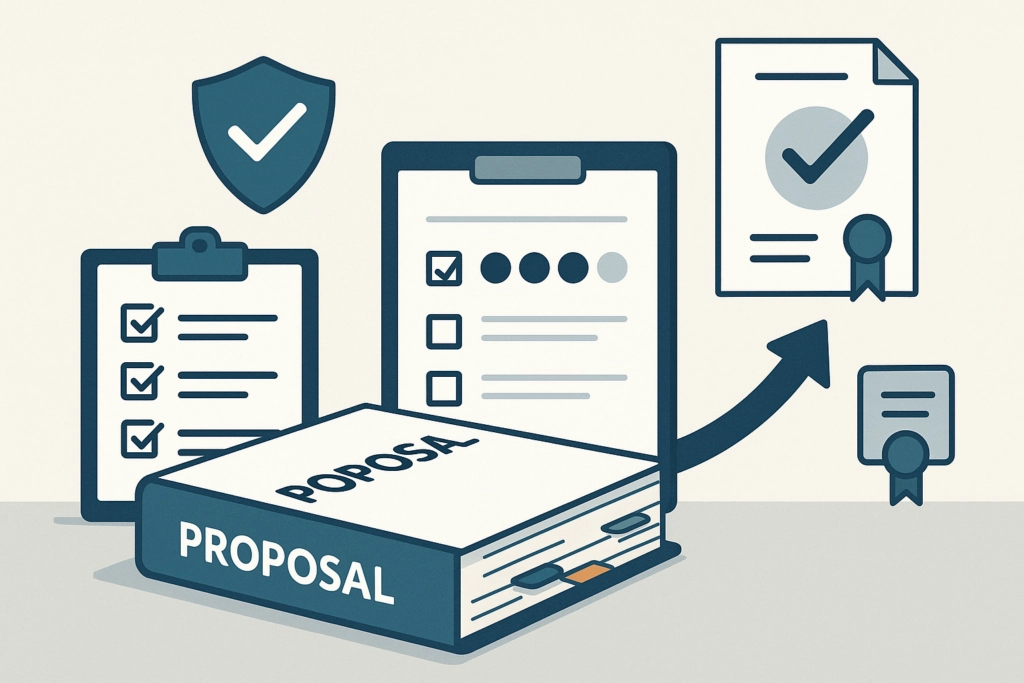
A proposal system is a set of tools, templates, roles, and checkpoints that makes every proposal predictable. Think of it as your Weapon: not aggressive, just disciplined—built to protect quality under deadline pressure.
Here’s what it looks like in real life. A small contractor finds a relevant opportunity on sam.gov, pulls the solicitation, and realizes the timeline is tight. With a system, your team doesn’t start from a blank page; they start from a proven structure, a Database of past performance narratives, and a documented Methodology for compliance and review.
A proposal system isn’t “more paperwork”—it’s fewer surprises
The goal isn’t to create bureaucracy. The goal is Confidence: knowing your response will be compliant, persuasive, and on time even when your best people are on a plane or buried in delivery.
If you’ve ever had a bid held together by late nights, Slack panic, and a single overworked capture lead, you already know the Pain. A system reduces that Pain by making the work visible and repeatable.
Proposal systems are a game-changer when you’re bidding on government and juggling federal business
Deadlines in government contracting don’t care that your SME is on PTO. Federal agencies publish RFP schedules, and procurement timelines move with or without you.
This is where proposal systems become a game-changer. They help you respond faster without turning your proposal into a generic proposal. Speed matters, but clarity and compliance matter more.
What changes when you systematize your bid response
Without a system, your proposal process is basically “hunt, scramble, submit, hope.” With a system, you can run parallel tracks: compliance, solution, pricing, and past performance—each with owners and deadlines.
- Faster kickoff: pre-built outlines mapped to evaluation criteria
- Cleaner writing: consistent voice, fewer contradictions, less rework
- Better reviews: color-team reviews that catch gaps early
- Less risk: version control and a single source of truth for Information
You still need smart people. But now your proposal teams aren’t reinventing the wheel every time a new RFP drops.
A quick scenario: the same contractor, two different outcomes
Imagine you’re a services contractor pursuing a federal contract for IT help desk support. In the “no system” world, your technical lead writes a solution that doesn’t match staffing, pricing uses outdated rates, and the final proposal contradicts itself in three places.
In the “system” world, your bid starts with a compliance matrix, your solution is built from a reusable playbook, and your past performance is pulled from relevant contracts already tagged by scope, customer, and metrics. The evaluator sees a coherent story, not a stitched-together document.
Beyond compliance: how winning government proposals persuade, not just comply
Yes, compliance requirements are non-negotiable. Following instructions is table stakes. But beyond compliance is where awards are decided—especially when multiple bidders are technically acceptable.
A strong proposal doesn’t just answer the question. It makes the decision-maker feel safe choosing you.
Write to the evaluator’s risk lens
Every evaluator is scanning for risk: delivery risk, staffing risk, cybersecurity risk, schedule risk. Your job is to reduce perceived risk with proof, not adjectives.
That means your proposal needs specific key points: measurable outcomes, clear roles, and a believable project execution plan. A winning proposal reads like you’ve done this exact work before—because you have, and you can prove it.
Use differentiation that’s real (and repeatable)
“We provide high-quality service” isn’t differentiation. Differentiation is a clear Proposition: what you do, how you do it, and why it lowers risk or improves outcomes for government buyers.
Example: instead of saying “fast onboarding,” you show a 30-day transition plan with deliverable checkpoints, training hours, and escalation paths. That’s persuasive because it’s concrete.
If you want a practical look at how systems support business proposals across industries, the guide on leveraging proposal systems to win more business contracts breaks down the same mechanics in a way you can adapt to govcon.
Build a repeatable process that improves win rates without submitting the most proposals
Submitting the most proposals feels productive. It’s also a fast way to burn out your best people and train your organization to accept sloppy work as normal.
Instead, build a repeatable process that helps you choose a strategic bid and execute it well. The best contractors treat bidding like portfolio management: fewer shots, higher quality, better odds.
Start with a simple bid/no-bid filter
Your filter doesn’t need to be complicated. It needs to be honest. If you can’t win, don’t bid.
- Fit: do you have relevant opportunities aligned to your capabilities and business profile?
- Access: do you have a relationship or a path to building relationships with the Customer?
- Proof: do you have past performance that maps to the scope and evaluation criteria?
- Capacity: can you staff it without breaking current delivery?
- Position: can you credibly position your approach against competitors’ strengths?
Systematize your capture-to-proposal handoff
Most proposal development fails at the handoff: capture knowledge lives in someone’s Mind, not in a shared workspace. Then proposal writing starts blind, and your team wastes days rediscovering basics.
A system forces capture to document what matters: buyer priorities, pain points, competitive positioning, and the win themes you’ll repeat throughout the proposal.
If approvals and internal handoffs are where your timelines collapse, automating your proposal approval workflow is a solid blueprint for removing bottlenecks without sacrificing accountability.
How to turn past performance into a winning proposal asset (not a dusty appendix)
Past performance is one of the few parts of a proposal that can feel like “proof” instead of promises. But only if it’s written and organized well.
Too many contractor teams treat past performance as a compliance attachment. They paste in old paragraphs, change a date, and hope it sticks.
Create a searchable library of relevant contracts
You want a Database that lets you find relevant contracts in minutes, not hours. Tag each project by agency, scope, contract type, NAICS, period of performance, and results.
Then build past performance narratives that include metrics: response time improvements, cost savings, uptime, training completion rates, or audit outcomes. This is the difference between “we did help desk” and “we reduced average time-to-resolution from 18 hours to 6 hours within 60 days.”
Map proof directly to evaluation criteria
If the RFP rewards transition planning, your past performance should highlight transitions. If it rewards cybersecurity controls, show the controls you implemented and how you documented them.
This is where a system shines: it prompts you to align evidence to the scoring model, not to your internal org chart.
Mini-checklist: a high-impact past performance write-up
- Context: who the Customer was and what problem they faced
- Scope: what you delivered (people, process, tools)
- Results: measurable outcomes tied to the agency’s pain points
- Relevance: why it matches this federal contract and this mission
- Lessons learned: what you’d repeat to reduce risk again
Use proposal software and ai-powered workflows to streamline proposal development (without losing quality)
Let’s be blunt: spreadsheets and shared drives don’t scale. If your contractor operation is growing, you need Software that supports version control, collaboration, and reuse—especially when multiple bids overlap.
The goal is to streamline proposal work so your experts spend time on substance, not formatting and scavenger hunts.
What “streamline proposal” should actually mean
Streamline doesn’t mean “write faster at any cost.” It means fewer manual steps, fewer errors, and fewer places for important Information to disappear.
A good system helps you streamline the mechanics: outlines, assignments, reviews, and content reuse. Your people still supply judgment, strategy, and credibility.
Where ai-powered support fits (and where it doesn’t)
Ai-powered tools can help summarize notes, suggest structure, and accelerate first drafts. They can’t replace your intelligence capabilities—your real understanding of mission, delivery constraints, and what government buyers will trust.
Use AI for speed, then rely on your SMEs to validate claims, align to the solicitation, and make the writing sound like your team, not a template.
Connect your proposal workflow to the money side
Winning government work is only half the story. After award, you still need clean estimates, invoicing, and reporting that match the Contract terms.
This is where tools like Invoice Crowd can support the operational side. Their proposal builder is designed for structured, reusable proposals, and the convert to invoice workflow helps you move from signed work to billing without rekeying everything.
If your team is trying to connect proposal data with billing and finance, best practices for combining invoicing and proposal systems lays out practical integration patterns that reduce errors and speed up cash flow.
Strategic bid planning: GSA schedules, contract vehicles, and set-aside paths that fit your position
Not every win comes from an open-market RFP. Many government opportunities flow through contract vehicles—paths that shape who can bid, how fast awards happen, and how agencies buy.
If you’re serious about federal business, you need a plan for gsa pathways, teaming, and set-aside strategy that matches your position in the market.
When GSA helps—and when it distracts
Getting on gsa can open doors, but it doesn’t automatically create pipeline. If your business development plan doesn’t include outreach to federal agencies and prime contractors, you’ll still be invisible.
Use gsa as a channel, not a strategy. The strategy is identifying upcoming contracts, understanding buyer behavior, and showing up with a credible offer.
Contract vehicles and the “speed advantage”
Contract vehicles can compress timelines. That’s great when you’re prepared—and brutal when you’re not.
A proposal system gives you reusable content blocks, pricing logic, and past performance mapped to typical scopes. That’s how you respond quickly without sacrificing quality.
Set-aside and sole-source: don’t waste your shot
Set-aside programs can be a powerful route for small businesses, but they’re competitive inside the category. Sole-source can happen, but it usually follows trust and a clear value story.
Either way, your proposal still needs to read like a safe decision. Your approach to government has to show low risk, clear delivery, and a realistic plan.
Competitive edge comes from positioning, relationships, and a proposal process that doesn’t break under pressure
Even the best proposal can’t fix weak market presence. If agencies don’t know you, you’re starting behind. That’s why your proposal system should support—not replace—relationship-driven growth.
Winning government work is a mix of competitive positioning, credibility, and execution discipline. The system ties those pieces together so they show up consistently in every bid.
Build relationships before the RFP drops
Building relationships doesn’t mean awkward coffee chats. It means showing up with useful insight: what you’re seeing in delivery, what risks you’ve solved, what outcomes you can reliably produce.
Talk to contracting officers when appropriate, attend industry days, and connect with primes where your capability fills a gap. A strong LinkedIn presence can help, too—especially when your SMEs share practical lessons instead of marketing fluff.
Position against competitors’ likely story
You don’t need to attack anyone. You do need to anticipate what a competitor will claim and make your differentiation clearer and safer.
Example: if prime contractors will pitch scale, you pitch responsiveness and specialized expertise with proof. If they pitch low price, you pitch fewer incidents, faster resolution, and lower total cost over the period of performance.
Make proposal professionals and SMEs work like one team
The best proposal professionals don’t just “wordsmith.” They manage structure, compliance, and narrative so SMEs can focus on the solution.
When the process is clear, senior leaders can review strategy and risk instead of fixing formatting at 11 p.m. That’s how you protect quality and keep your best people engaged.
FAQ: practical answers for teams trying to win more government work
Are you having a tough time winning government contracts?
If you’re losing despite being qualified, the issue is usually consistency: weak positioning, thin proof, or a proposal process that breaks under deadline. A proposal system gives you structure so each bid improves instead of starting over.
Have you ever wondered how government contracting evolved to the thriving $4.4 trillion industry it is today?
It grew as governments standardized procurement to buy at scale, manage risk, and document fairness. That standardization is why proposal compliance and evaluation criteria matter so much in modern govcon.
How Can You Register as a Government Contractor?
Most teams start by creating required registrations and completing profiles used by buyers and systems. Get your business profile tight and consistent, because mismatched info can slow down awards and teaming conversations.
How to Win a Government Contract?
Pick relevant opportunities, build relationships early, and submit a compliant, persuasive proposal that reduces risk for the evaluator. Focus on proof—past performance, clear staffing, and a credible project execution plan.
Where Can You View Federal Business Opportunities?
sam.gov is the primary place to find posted federal opportunities, along with agency forecasts and vehicle-specific portals. Use market research to track upcoming contracts so you’re not reacting at the last second.
Conclusion: make proposal systems your secret weapon for proposal success
If you want proposal success that scales, treat your proposal function like a system, not an event. The contractors who win consistently aren’t always the biggest bidder—they’re the ones who can position clearly, prove past performance, meet compliance requirements, and deliver a clean, persuasive proposal every time.
When you’re ready to make that shift, build your repeatable process, tighten your strategic approach, and support it with tools that keep your workflow organized from proposal to delivery. Invoice Crowd is built for teams that want proposals and operations to run with less chaos and more Confidence—so you can spend more time winning government work and less time reinventing the wheel.