
Enter debit and credit lines together
Choose an account for each line and enter a value on exactly one side. Invoice Crowd rejects a one-line, mixed-side or unequal journal even if client-side checks are bypassed.
Accounting
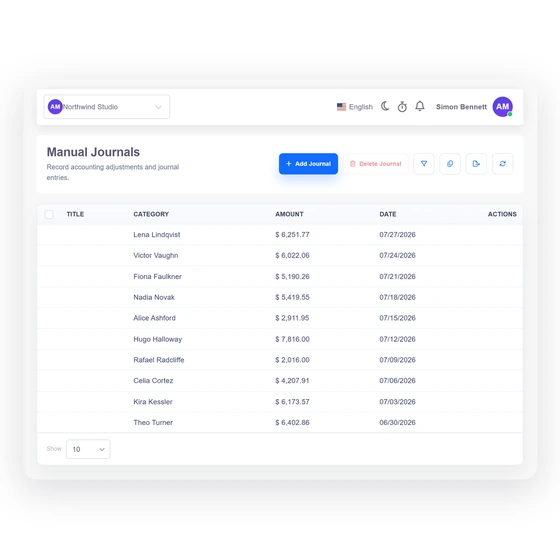
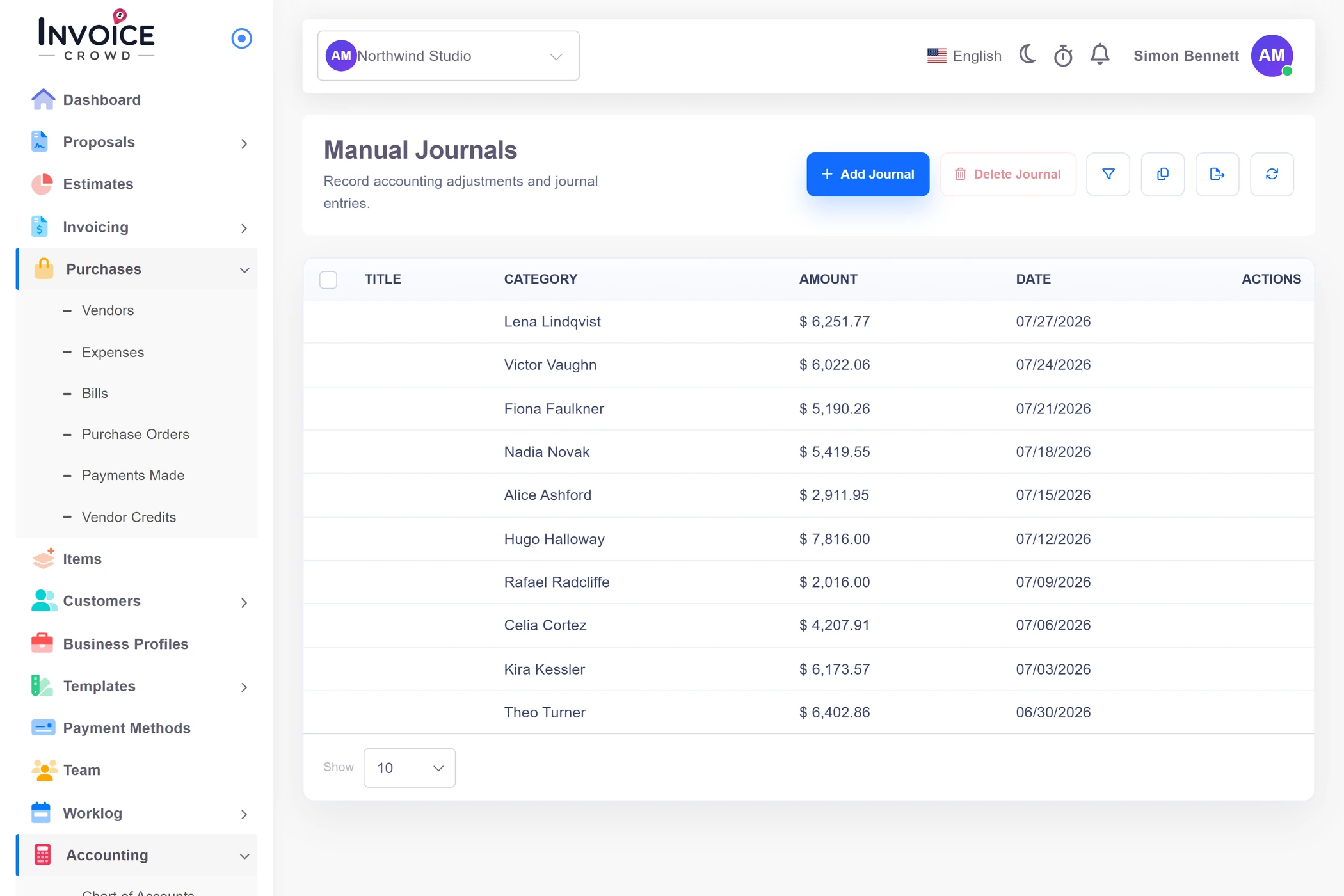
Manual Journals records adjustments that do not begin as an invoice, expense or payment. Each batch needs at least two valid lines, exactly one debit or credit per line, and equal totals before Invoice Crowd accepts it.
Last updated:
How it works
A journal is saved as a batch of account lines. Validation and business scoping happen on the server, while period locks prevent an adjustment from quietly changing a closed period.
Title, date, currency, evidence and account lines.
Choose an account for each line and enter a value on exactly one side. Invoice Crowd rejects a one-line, mixed-side or unequal journal even if client-side checks are bypassed.
A journal carries a title, description, currency, date and optional receipt. The individual rows share a batch token so they are managed as one entry.
The selected business and journal date remain part of every mutation.
When the business is locked through the journal date, the server returns a locked-period response before changing rows. Editing also checks the original date so a journal cannot be moved out of a closed period as a shortcut.
A submitted business id must match the owner's currently selected business, and selected accounts must belong to the owner or the default chart. Linked invoice, expense and payment rows are excluded from this manual surface.
Preserve the batch boundary and avoid silent historical claims.

Editing updates the active lines in the same owner, business and batch; removed lines become inactive. Deleting marks the eligible batch rows deleted and deactivates the corresponding journal event rather than reaching into unrelated entries.
Current saves enforce balance, but older imported or legacy data may contain journal batches created before those guards existed. The accounting audit commands report those cases; they do not guess a correction.
Built in
The form, balancing rule, lifecycle and limitations an accountant should know before using Manual Journals.
Choose an account for each line and enter a value on exactly one side. Invoice Crowd rejects a one-line, mixed-side or unequal journal even if client-side checks are bypassed.
A journal carries a title, description, currency, date and optional receipt. The individual rows share a batch token so they are managed as one entry.
When the business is locked through the journal date, the server returns a locked-period response before changing rows. Editing also checks the original date so a journal cannot be moved out of a closed period as a shortcut.
A submitted business id must match the owner's currently selected business, and selected accounts must belong to the owner or the default chart. Linked invoice, expense and payment rows are excluded from this manual surface.
Editing updates the active lines in the same owner, business and batch; removed lines become inactive. Deleting marks the eligible batch rows deleted and deactivates the corresponding journal event rather than reaching into unrelated entries.
Current saves enforce balance, but older imported or legacy data may contain journal batches created before those guards existed. The accounting audit commands report those cases; they do not guess a correction.
The server verifies both sides before writing.
All lines commit together or roll back.
Closed periods reject create, edit and delete.
Export the business profile's manual journal collection.
Journal lines use accounts from the active chart.
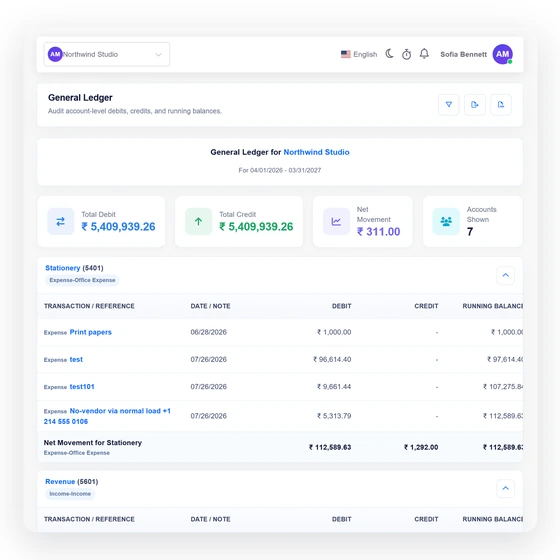
Review how the period's account movements classify.
Questions
A manual journal is an adjustment entered directly as two or more account lines rather than created from an invoice, expense, income or payment. Every line belongs to one batch.
Current Manual Journals validation requires equal debit and credit totals, at least two valid lines and exactly one side per line. An invalid payload is rejected before the batch is written.
No. Invoice Crowd checks the selected business and the journal date against accounting period locks. An edit also checks the original date, so moving a journal cannot bypass the lock.
Yes. The journal form supports an optional receipt attachment alongside its title, description, date, currency and account lines.
The Manual Journals delete path resolves only eligible manual rows in the same owner, selected business and batch. Invoice-, expense-, income- and payment-linked rows are outside this mutation surface.
No. Current writes are validated, but historic rows created before the newer guards may still require review. Invoice Crowd's audit commands report issues without inventing an accounting correction.
Use a manual journal when no ordinary document tells the story, and keep the accounts, evidence and period boundary together.