
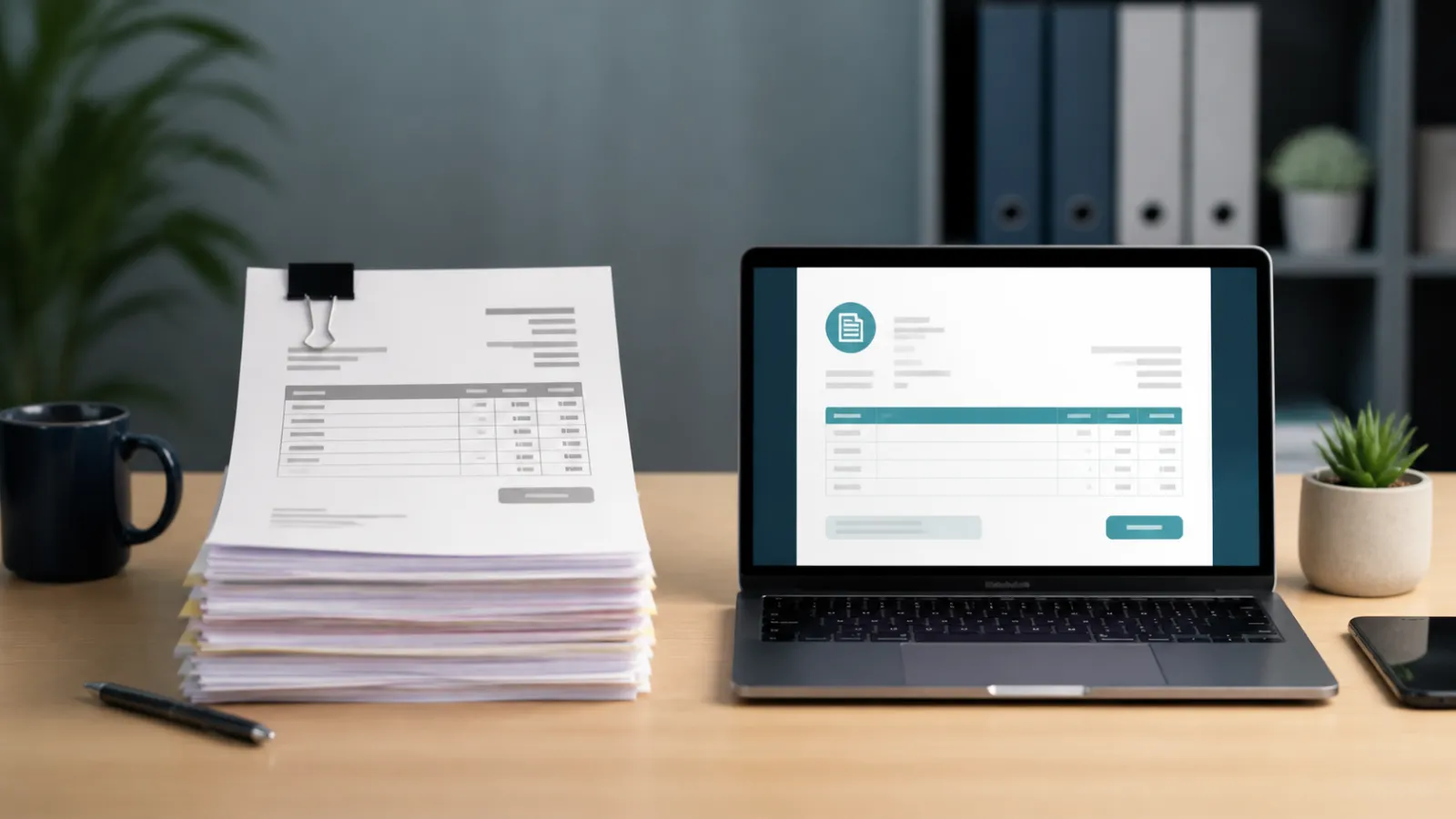
Short answer: a PDF invoice is a digital picture of an invoice. A structured electronic invoice is data in a standard format that accounting systems can validate and post without somebody retyping it. Emailing a PDF is electronic delivery, but it is not structured e-invoicing.
That difference sounds technical until a customer rejects your PDF, a government buyer asks for Peppol, or an accounts payable team says it can no longer key invoices by hand. Then the format becomes the difference between an invoice that enters the payment queue and one that comes back.
PDF invoice vs electronic invoice
| Question | PDF invoice | Structured e-invoice |
|---|---|---|
| What is it? | A visual document designed for a person | Machine-readable fields in an agreed standard |
| How is it read? | By a person or OCR | Directly by accounting software |
| Can fields be validated? | Only after extraction | Before the document is accepted |
| Typical delivery | Email, portal download, file share | Peppol or another regulated network |
| Common formats | UBL, CII, or a country profile built on them |
A PDF can be born digital and still be unstructured. The amount, tax rate and supplier number may look obvious on screen, but to a receiving system they are pixels and positioned characters. Optical character recognition can guess what those characters mean. A structured invoice does not ask it to guess.
What makes an invoice structured
A structured invoice gives each fact a defined place and meaning. The buyer identifier is not merely a line near the top. It is a buyer-identifier field. The tax total is not whichever bold number appears above the grand total. It is a tax-total field with currency and calculation rules.
That structure lets the receiving system answer useful questions before payment:
- Is the supplier identifier valid?
- Does the invoice currency match every monetary amount?
- Do line totals, allowances, tax and the payable amount add up?
- Is a required purchase order reference present?
- Has this invoice number already been received from this supplier?
The European Commission describes electronic invoicing as the exchange of an invoice in a structured data format that allows automatic electronic processing. OpenPeppol describes the network and document specifications used to move that data between access points. Those definitions are why a PDF attachment does not qualify by itself.
What about a hybrid invoice
Some standards combine both forms. The recipient sees a familiar PDF, while a structured XML invoice is embedded inside it. A human can open the document and a compatible accounting system can read the data layer.
Hybrid does not mean any PDF with metadata. The embedded data still has to follow the expected standard, agree with the visible document, and pass the receiver’s rules. If the visible total says 1,200 and the data layer says 1,020, the document is not clever. It is inconsistent.
Why businesses are moving beyond PDF
Less data entry
A structured invoice can create a draft bill with the supplier, dates, lines, tax and totals already classified. A person reviews exceptions instead of typing every invoice.
Earlier error detection
A network can reject a missing identifier or broken total before the invoice reaches the buyer. Email usually reports only that a message was delivered, not that the invoice can be processed.
A traceable delivery path
Structured networks return delivery and validation states. That does not guarantee payment, but it removes the argument about whether the attachment arrived.
Compliance
Public procurement and business-to-business mandates increasingly define e-invoicing as structured exchange. The exact rule, date and accepted profile depend on the buyer and jurisdiction, so always check the relevant authority rather than assuming that one country’s rule travels with you.
When a PDF is still appropriate
PDF remains useful when the customer is a consumer, a small business without an automated receiving system, or a buyer that explicitly accepts email. It is easy to view, archive and print. The mistake is not using PDF. The mistake is treating it as interchangeable with a structured document when the receiver has asked for one.
Ask three questions before sending:
- Does the buyer require a network, portal or document profile?
- Which buyer identifier and purchase reference must be present?
- Will the recipient accept a visual copy as well as the structured record?
Choose the right invoice delivery path in Invoice Crowd
Invoice Crowd supports readable customer invoices for ordinary delivery and a dedicated Peppol-ready UBL workflow for supported structured invoices. Both paths connect with the same customer, commercial terms, invoice totals, payment status and accounting record.
Explore invoicing and Peppol e-invoicing, or start with Invoice Crowd.
Sources and scope
This guide was reviewed in August 2026 against the European Commission invoicing guidance and OpenPeppol’s network explanation. It explains the format distinction, not the filing rules of any one country.
Frequently asked questions
Is emailing a PDF considered e-invoicing?
It is electronic delivery, but it is not structured e-invoicing. The recipient still has to read the document or use OCR to extract its fields. A structured e-invoice carries those fields in an agreed machine-readable format.
Can OCR turn a PDF into an electronic invoice?
OCR can extract data from a PDF and use it to create a structured record, but the PDF itself does not become structured. The extracted values still need validation because OCR can confuse dates, totals, tax rates and identifiers.
Is a Peppol invoice a PDF?
The primary Peppol document is structured data that follows a specified business document profile. A human-readable rendering may be supplied alongside it, but the structured document is what the network validates and delivers.
What is a hybrid electronic invoice?
A hybrid invoice combines a readable PDF with a structured data file embedded inside it. It works only when the data follows the expected standard and matches the visible document exactly.
Do all customers need structured invoices?
No. Requirements depend on the buyer, contract and jurisdiction. Many consumers and small businesses still accept PDF. Government buyers and businesses covered by an e-invoicing mandate may require a specific network or format.
Should I send both a PDF and a structured invoice?
Send both only if the buyer or receiving network supports that workflow. The structured invoice should remain the authoritative machine record, and any visual copy must show the same identifiers, lines, tax and totals.