Studio Vahl, a 12-person branding agency in Rotterdam, keeps its books in euros. This spring it billed a Boston client $10,000, a London client £6,000 and a Tokyo client ¥1,500,000. Selling internationally was easy, and each international invoice took minutes. The trouble came at month end, when the agency had to explain why its receivables kept moving although nobody had changed an invoice.
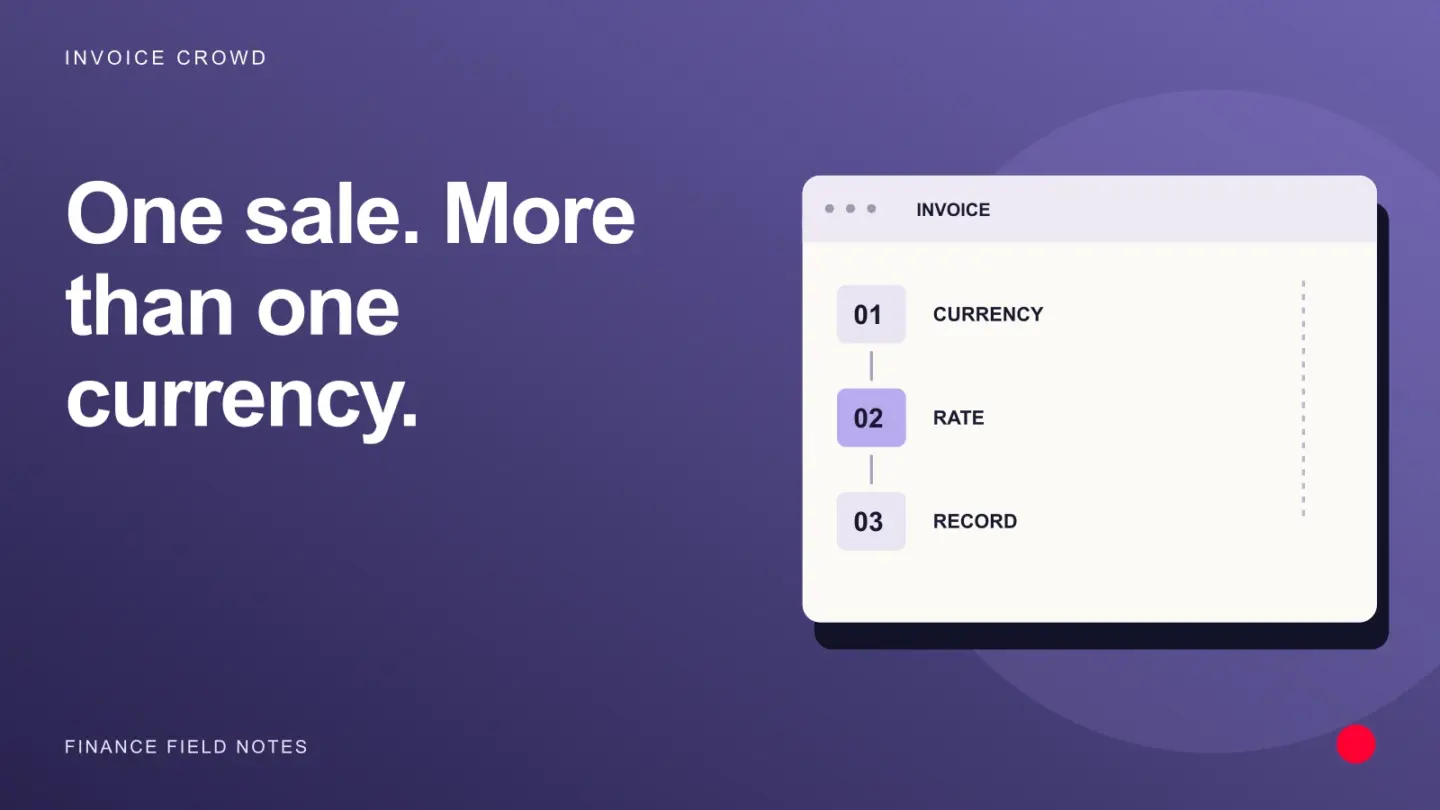
Multi-currency invoicing means billing each client in an agreed currency while your books stay in one accounting currency. To get it right, convert each invoice at the exchange rate for its date, freeze that rate on the record, round to each currency’s own decimals, and post the difference at payment as an exchange gain or loss.
Two currencies on every international invoice
Every cross-border transaction has two money dimensions, and confusing them causes most multi-currency problems.
- The transaction currency. What the document is denominated in: the customer’s on an invoice, the supplier’s on a bill.
- The accounting currency. The single unit your ledger, balance sheet and profit and loss statement are read in, sometimes called the functional or base currency.
Studio Vahl’s Boston invoice is both. It is 10,000 United States dollars to the customer and, at a rate of 0.92, €9,200 in the agency’s ledger. Both figures are real, and both need keeping.
Which exchange rate to use for each transaction
Invoicing systems differ here, so learn what yours does before an auditor asks.
| Situation | What should happen |
|---|---|
| Transaction is in your accounting currency | Rate is 1, so nothing needs converting. |
| Dated today | Today’s verified rate, frozen onto the record when you save it. |
| Backdated | The rate for that date, which needs a source with history. |
| Future-dated | No rate exists yet, so anything used is provisional. |
| You type your own rate | Used as entered, and visibly different from the source rate so a later reader knows. |
Tax authorities can set the source for you. For UK VAT, HMRC’s VAT Notice 700 (paragraph 7.6) requires the UK market selling rate at the time of supply, unless you choose HMRC’s published period rates or get written approval for a commercial rate. Our guide to which exchange rate to use on an invoice compares the usual sources of currency exchange rates.
The backdating problem
Many free rate feeds serve current rates only. Enter an expense dated three weeks ago and there may be no historical rate to look up. The honest options are to find the rate that applied on that date, or to type it yourself and record where it came from.
Avoid any system that silently uses today’s rate for a backdated entry. The number looks plausible, and a year later nobody can tell it was never the real rate.
Freeze the rate, do not recalculate it
Once a transaction is saved, its converted amount should never change. If your system re-converts historic entries when rates move, last month’s closed accounts will quietly differ from what you reported and from your tax reporting. The rate at the time of invoicing is the figure you booked.
Tax requirements and compliance across borders
Currency conversion is only half of cross-border compliance. Tax laws and regulations decide what the document must say, and they follow where the goods or services are supplied, not where you are based.
- EU invoice contents. The European Commission lists the mandatory details, including a unique sequential invoice number, both parties’ names and addresses, the tax rate and amount, and the customer’s VAT number where the customer is liable for the tax. When the reverse charge applies, the invoice must carry the words “reverse charge”.
- Tax shown in local money. Under paragraph 16.4 of the same HMRC notice, a UK value-added tax invoice issued in euros or dollars must show the total tax payable converted into pounds sterling.
- Withholding tax. Some clients must withhold tax from payments for services. Ask before you quote, and agree in the contract whether your price is gross or net.
Invoice rules in different countries change often, so confirm compliance with local regulations through the tax authority of each market you bill into. Our overview of what a tax invoice must show covers the domestic basics.
Rounding is not always two decimals
A surprisingly common bug is assuming every currency has two decimal places. The ISO 4217 standard says otherwise.
| Minor units | Currencies | Example |
|---|---|---|
| 0 | JPY, KRW, VND, ISK, CLP and others | ¥1,500,000, never ¥1,500,000.00 |
| 2 | Most, including USD, EUR and GBP | $19.99 |
| 3 | KWD, BHD, OMR, TND and others | KWD 12.345 |
Get this wrong and you produce documents that look wrong to the recipient and totals that fail validation on structured electronic invoicing networks, which slows invoice processing on the buyer’s side.
Where to round
Round at the end rather than at each step. Converting and rounding each line, then summing, gives a total that can differ by a cent or a yen from converting the sum. Neither is wrong in principle, but the customer will notice the gap.
Exchange gains and losses when an international payment arrives
Studio Vahl invoiced $10,000 when it was worth €9,200. The client paid two months later, when the same dollars converted to €9,050. The agency received exactly what it invoiced, yet its books are €150 short. That difference is a realized exchange loss, a real cost of international business. Until payment arrives, each open international invoice moves with every currency fluctuation, so treat its home-currency value in cash flow forecasts as an estimate.
The journal entry on the payment date:
| Account | Debit | Credit |
|---|---|---|
| Bank | €9,050 | |
| Foreign exchange loss | €150 | |
| Accounts receivable | €9,200 |
The loss belongs in its own account, not buried in revenue, because it is not a trading result. Bank fees on international transactions are a separate cost and go to bank charges, which keeps payment reconciliation clean.
Currency, payment method and billing decisions for global transactions
Managing international pricing: which currency to invoice in
- Your own is simplest and puts the foreign exchange risk on the customer. Fine for strong relationships, occasionally a barrier in competitive bids.
- Their local currency wins work with international customers and puts the risk on you. Usually worth it, and worth pricing in.
- A third currency, usually USD, is common in some industries and means both parties carry risk.
For large or long contracts, a bank can fix a future rate with a forward contract. That hedge turns volatility into a known cost.
Payment methods for cross-border transactions
The exchange rate is rarely the biggest cost of an international payment. Bank margins on incoming wire transfers, intermediary fees and poor conversion at the receiving end usually exceed the market spread. Euro payments inside the Single Euro Payments Area travel as SEPA transfers or direct debit, cards suit smaller invoices, and providers built for cross-border payments are often cheaper than a traditional wire. Compare currency conversion fees on your own numbers with our guide to ACH, wire transfer and credit card payments.
Whichever payment method you offer, print the invoice number as the payment reference and state who pays transfer fees. That small step in the payment process is what gets timely payments matched to the right invoice.
Manage international invoices in Invoice Crowd
In Invoice Crowd, each business profile has a billing currency and an optional separate accounting currency, and every invoice has its own currency picker. A back-dated document uses that date’s exchange rate, never today’s, and asks you to enter one if none is stored. A rate you type that sits more than 10% from the verified rate, is inverted or equals exactly 1 must be confirmed before it saves. Customer statements show a separate amount due for each currency.
Explore multi-currency invoicing or start with Invoice Crowd to manage international clients with clearer financial records.
A checklist for the challenges of international invoicing
- Set your accounting currency once and deliberately, before the books hold entries.
- Never re-convert a saved record.
- Confirm minor units for every currency you bill in, especially JPY and the Gulf currencies.
- Give exchange differences their own account so they never masquerade as trading performance.
- Record the rate source alongside each transaction. A number with no provenance is a number you cannot defend.
- Keep one invoice template per client language, with the payment details for that currency.
For the client conversation that comes first, see how to invoice international clients in multiple currencies.
Frequently asked questions
What exchange rate should an invoice use?
The rate for the invoice or supply date, frozen onto the record so it never changes afterwards. Where tax applies, the authority may set the source: for UK VAT it is the UK market selling rate at the time of supply, or HMRC’s period rates if you adopt them.
What happens with an expense dated last month?
It should use the rate for its own date, not today’s. Invoice Crowd looks up the stored or historical rate for that date and, if none exists, asks you to enter the rate that applied. In a system without rate history, type the rate yourself and note where it came from.
Can I invoice in a foreign currency?
Usually, yes. Most businesses can bill in whatever the client agrees to, but tax rules may require some amounts in local money. A UK VAT invoice in euros or dollars, for example, must still show the total tax in sterling. Check the rule in each country where you charge tax.
Can I change my accounting currency later?
In Invoice Crowd, only before any entries are recorded. Once the books hold entries, the accounting currency is locked. To keep books in another currency, set up a separate business profile.
Should I invoice in my currency or the customer’s?
It is a commercial decision about who carries the exchange risk. Billing in your own is simplest and puts the risk on the customer. Billing in theirs wins work and puts the risk on you, which is usually worth it and worth pricing in. Either way, record exchange differences in their own account.