
Accounts payable and accounts receivable are the two halves of the same idea: work has been done and money has not yet moved. One is money you owe. The other is money owed to you. Between them they explain most of the gap between a business being profitable and a business having cash in the bank.
They are also the two accounts most often confused, usually because the names are similar and both involve invoices.
The short version
| Accounts receivable | Accounts payable | |
|---|---|---|
| What it is | Money customers owe you | Money you owe suppliers |
| Balance sheet | Current asset | Current liability |
| Created by | Issuing an invoice | Receiving a bill |
| Cleared by | The customer paying you | You paying the supplier |
| You want it | Low and young | Managed, not minimised |
| Key metric | Days sales outstanding | Days payable outstanding |
The asymmetry in that last row is the interesting part, and most guides get it wrong. Receivables are a problem to be reduced. Payables are a resource to be managed. Paying every supplier the moment their bill arrives is not prudence, it is giving away free financing.
Accounts receivable, properly understood
The moment you issue an invoice, you have made a loan. You have delivered the work, you have not been paid, and you are carrying the cost of that gap. Accounting recognises this by recording revenue and an asset at the same time: the revenue you earned, and the receivable that represents your right to collect it.
The receivable cycle
- Work is delivered and an invoice is issued. Revenue up, receivables up.
- The invoice ages through its payment terms.
- The customer pays. Receivables down, cash up. Revenue is untouched, because it was already recognised.
That third step is where the confusion usually sits. Receiving payment on an invoice is not income. The income happened when you issued the invoice. The payment is one asset turning into another.
Ageing is the whole discipline
A single receivables total tells you almost nothing. What matters is how old the balance is, because collectability falls sharply with age. A standard accounts receivable ageing view buckets what you are owed by how overdue it is: current, one to thirty days, thirty-one to sixty, sixty-one to ninety, and over ninety.
Two businesses can both be owed the same amount and be in completely different health. One has it all in the current bucket. The other has half of it past ninety days, which is a polite way of saying some of it is never arriving.
Days sales outstanding
DSO is the average number of days between invoicing and being paid:
DSO = (Accounts receivable / Credit sales in the period) x Days in the period
Track the trend rather than the absolute number. A DSO of forty-five is fine in an industry where everyone works on net 30 and slips. A DSO of forty-five is alarming if your terms are net 14 and it was twenty-two last quarter.
Accounts payable, properly understood
Accounts payable is the mirror image. A supplier delivers, sends a bill, and until you pay it you are holding their money. Recording the bill puts the cost in the period the cost belongs to and creates a liability for the amount.
The payable cycle
- You order, usually with a purchase order.
- Goods or services arrive.
- The supplier bills you. Expense up, payables up.
- You pay. Payables down, cash down.
The reason the purchase order exists is step five, which is not really a step: the check that all three documents agree. What was ordered, what was received, what was billed. Where they disagree, someone has made a mistake and you would rather find it before the money leaves.
Days payable outstanding
DPO = (Accounts payable / Cost of goods sold in the period) x Days in the period
A higher DPO means you are holding cash longer. Within your agreed terms this is free working capital. Beyond them it is a relationship problem that eventually becomes a supply problem, and stretching payables is the cheapest financing available right up until the moment it becomes the most expensive.
The two together: the cash conversion gap
Put the metrics side by side and you get the question that actually matters. If your customers take sixty days to pay you and your suppliers expect payment in thirty, you are financing thirty days of your own trading. Grow the business and that gap grows with it. This is how a business with a healthy profit and loss statement runs out of money.
There are only three levers:
- Get paid sooner. Shorter terms, deposits up front, payment links on the invoice so paying is a click rather than a task, and late fees that are stated in advance rather than invented in anger.
- Pay later, within terms. Negotiate terms rather than simply taking them, and pay on the due date rather than on receipt.
- Reduce the gap in the middle. Invoice faster. The delay between finishing work and issuing the invoice is entirely self-inflicted and is often the largest single component of DSO.
How Invoice Crowd connects accounts payable and receivable
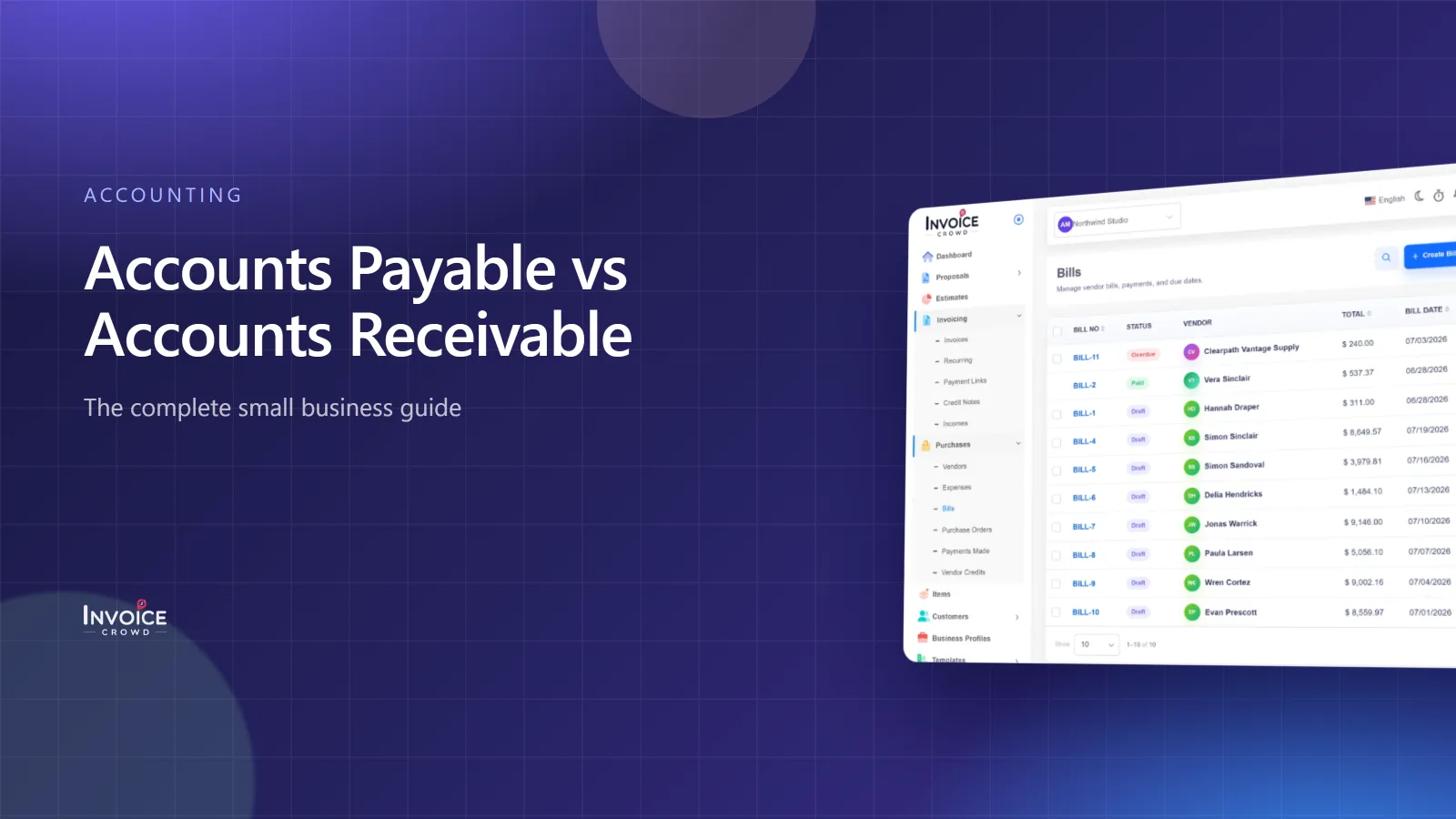
Invoice Crowd keeps both sides of working capital in one business context. Customer invoices, balances, payment records and receivable aging connect with vendors, purchase orders, bills, vendor credits and payments made. The general ledger and financial reports then provide a shared view of the activity behind each balance.
Use the bills and accounts payable workflow alongside customer invoicing, or start with Invoice Crowd to bring both cycles together.
A short checklist
- Invoice on the day the work is done, not at month end.
- Review the ageing report weekly, not monthly. Ninety days late started as five days late.
- Record bills when they arrive, not when you pay them, or your expenses land in the wrong period.
- Match purchase order, receipt and bill before paying anything material.
- Track DSO and DPO as a trend. The direction matters more than the number.
Frequently asked questions
Is accounts receivable an asset or revenue?
It is an asset. Revenue is recognised when you issue the invoice and deliver the work. The receivable is the asset representing your right to collect the cash for that already-recognised revenue. When the customer pays, one asset (receivables) turns into another (cash) and revenue does not change at all.
Should I try to keep accounts payable as low as possible?
No, and this is the most common mistake in the subject. Within your agreed terms, an unpaid supplier bill is interest-free working capital. The goal is to pay on the due date rather than on receipt, and to negotiate terms rather than accept whatever arrives. Paying beyond your terms is a different matter and damages the relationship you depend on.
What is a good days sales outstanding number?
It depends entirely on your terms and your industry, so the absolute figure is less useful than the trend. If you invoice on net 30, a DSO in the mid thirties is healthy. What matters is whether it is rising. A DSO climbing quarter on quarter means collections are slipping regardless of what the number is.
Does Invoice Crowd pay my suppliers for me?
No. Invoice Crowd records vendor payments rather than making them. The payments made screen captures the vendor, the bill, the amount, the date, a reference number and a receipt, then reduces the bill balance and updates the ledger. The funds themselves move through your bank or your payment provider.
When should I record a supplier bill, on receipt or on payment?
On receipt, if you are on accrual accounting. Recording it when it arrives puts the cost in the period the cost belongs to and creates the payable. Recording it only when you pay pushes expenses into the wrong month and makes your profit and loss statement misleading in both directions.
What is the difference between accounts payable and expenses?
An expense is the cost itself. Accounts payable is the obligation to pay for it. Recording a supplier bill creates both at once: the expense on the profit and loss statement and the liability on the balance sheet. Paying the bill clears the liability and does not touch the expense, because the expense was already recorded.