
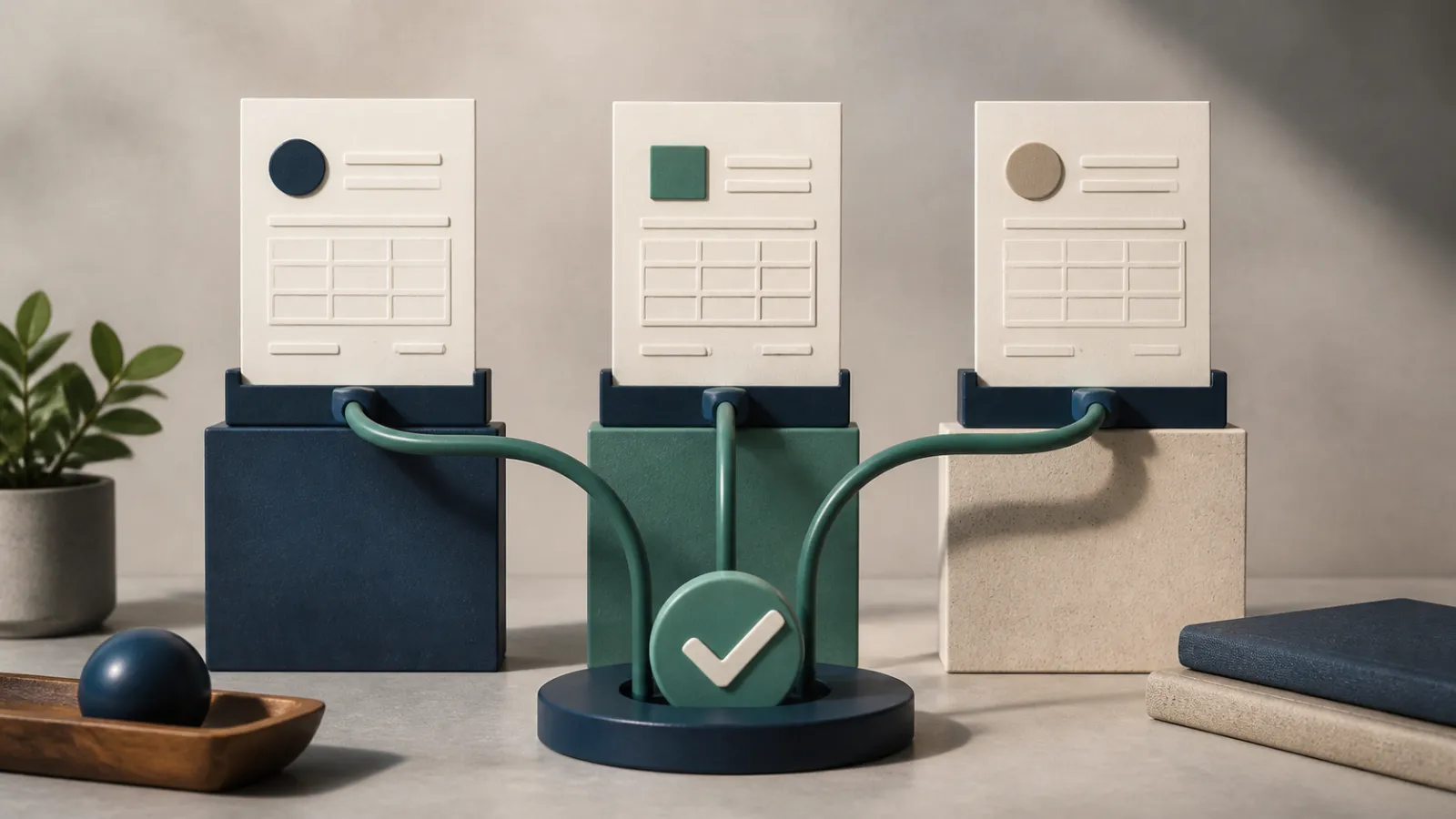
Three-way matching is a pre-payment control that compares what you authorized, what you received and what the supplier billed. The three records are the purchase order, the goods receipt or service confirmation, and the supplier bill.
If all three agree within an approved tolerance, the bill can move to approval. If they do not, the difference becomes an exception with an owner. The goal is not to make every document identical. It is to make every difference visible before cash leaves.
The three records
| Record | Question it answers | Key fields |
|---|---|---|
| Purchase order | What did we authorize? | Vendor, item, quantity, price, terms, currency |
| Receiving record | What actually arrived? | Item or service, accepted quantity, date, condition |
| Supplier bill | What are we being asked to pay? | Invoice number, lines, tax, total, due date, bank details |
The match should happen at line level when the purchase matters. A total can agree while one line is overbilled and another is missing. Header-only matching is faster, but it is weaker evidence.
A worked example
A studio orders 100 printed folders at 4 each. The purchase order value is 400. Ninety-eight acceptable folders arrive. The supplier bills 100 folders at 4.20, total 420 before tax.
| Test | Authorized | Received | Billed | Result |
|---|---|---|---|---|
| Quantity | 100 | 98 | 100 | Exception |
| Unit price | 4.00 | Not applicable | 4.20 | Exception |
| Vendor | Same supplier | Same supplier | Same supplier | Match |
The payable team should not change the order to 4.20 and mark two units received just to make the screen green. It should ask whether the buyer approved the price increase and whether the missing units will arrive. The acceptable outcomes are a corrected bill, a back order, a credit, or an approved exception with evidence.
What to match
- Supplier identity and remit-to details.
- Purchase order number and buyer.
- Item or service description.
- Quantity ordered, received and billed.
- Unit price, discount, freight and other charges.
- Currency, tax treatment and total.
- Delivery or service period.
- Payment terms and due date.
Bank details do not belong to the mathematical match, but a change to them belongs to the risk review. Verify it independently before payment.
How to set tolerances
A zero-tolerance rule creates noise over rounding and freight. A loose percentage quietly approves large differences. Use a small absolute limit, a percentage limit, and category rules together.
For example, allow the lower of 5 or 1 percent on routine supplies, but require exact quantity for controlled inventory and exact price for contracted services. Tax rounding can have its own narrow tolerance. Any bank-detail change should have no automatic tolerance at all.
Two-way, three-way and four-way matching
| Method | Records | Best fit |
|---|---|---|
| Two-way | Purchase order and bill | Services where formal receiving adds little |
| Three-way | Order, receipt and bill | Most material goods and services |
| Four-way | Order, receipt, inspection and bill | Quality-controlled or regulated purchases |
Support three-way matching with connected purchasing records
Invoice Crowd keeps the vendor, approved purchase order, resulting bill, payment record and accounting context available in one purchasing workspace. That connected evidence makes it easier to compare what was ordered, what was received and what the supplier billed before payment is recorded.
Explore purchase orders, bills and payments made, or start with Invoice Crowd.
Frequently asked questions
What are the three documents in a three-way match?
The purchase order, the receiving record or service confirmation, and the supplier bill. Together they show what was authorized, what arrived, and what the supplier wants to be paid.
What happens when the documents do not match?
The bill becomes an exception. A named owner investigates the quantity, price, tax, freight or supplier difference and resolves it through a corrected bill, credit, back order or documented approval.
Does every purchase need three-way matching?
No. Two-way matching may be enough for low-risk services or recurring charges. Three-way matching is most valuable for material purchases where quantity, delivery and price can differ.
What is a matching tolerance?
A small approved difference that can pass without manual escalation, often for rounding or minor freight. Good tolerances combine a low absolute amount, a percentage cap and stricter rules for sensitive categories.
Can the purchase order be edited to match the bill?
Not merely to clear the exception. That erases the original authorization. A genuine approved change should be documented as a change, with who approved it and when.
Does three-way matching prevent duplicate invoices?
It helps, but a separate duplicate check is still required. The same bill can match the same order twice, especially if the order remains convertible, so supplier and invoice-number controls remain essential.