Ridgeway Supply, a distributor of commercial cleaning products, closes its year on December 31 with $150,000 in accounts receivable. The owner knows some of it will never arrive: $5,000 is more than 90 days overdue, and a restaurant customer has stopped returning calls. Reporting the full $150,000 as an asset would overstate the balance sheet. Waiting until a customer actually defaults would push this year’s loss into next year.
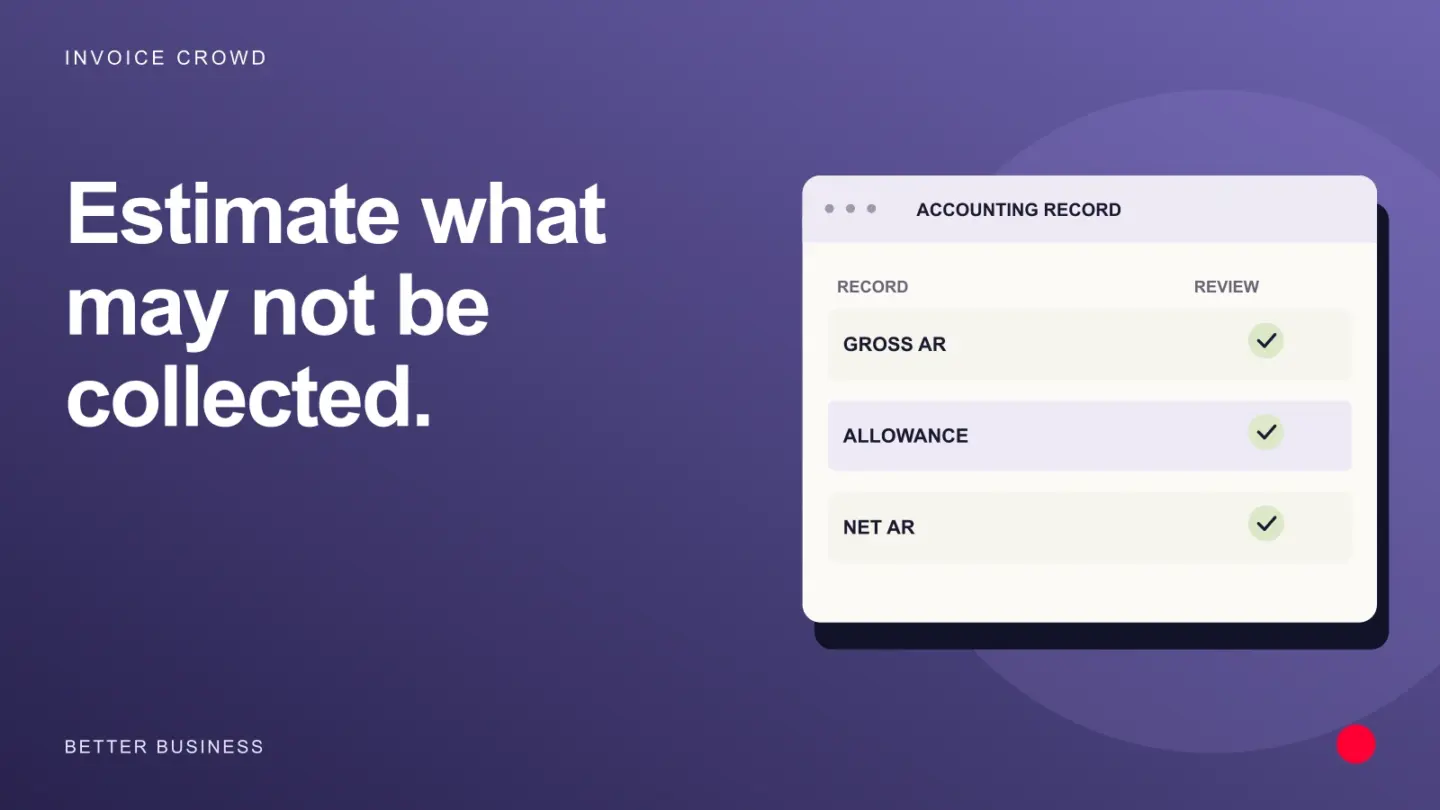
The allowance for doubtful accounts is a contra-asset account that reduces gross accounts receivable to the amount a business expects to collect. You estimate it at each period end, record the change as bad debt expense, and later write specific uncollectible invoices off against it.
How the allowance for doubtful accounts works
When you sell on credit, you record revenue and a receivable at the same time. Some customers will not pay, but on the day of the sale you cannot know which ones. The allowance solves that. It holds an estimate of expected bad debts without naming the invoices, so each receivable stays in the customer’s account while the amount reported on the balance sheet reflects what will be collected.
The allowance for doubtful accounts is a contra asset: it sits under accounts receivable and carries a credit balance, the opposite of the asset’s normal debit balance. You will also see it called the allowance for uncollectible accounts, the allowance for bad debt, the bad debt reserve or, in the language of the US credit losses standard, the allowance for credit losses. They all describe the same account.
| Ridgeway Supply balance sheet, December 31 | Amount |
|---|---|
| Accounts receivable | $150,000 |
| Less: allowance for doubtful accounts | ($6,650) |
| Accounts receivable, net | $143,350 |
The point is the matching principle. The cost of invoices that go unpaid belongs in the same accounting period as the credit sales that created the risk, not in the period when you finally give up. Accurate financial reporting also helps you make better decisions about extending credit, and gives lenders numbers they can trust.
Allowance method vs direct write-off method for bad debts
There are two ways to account for bad debts. The allowance method estimates the loss each period and records it before any specific account fails. The direct write-off method records bad debt expense only when an account is deemed uncollectible.
| Allowance method | Direct write-off method | |
|---|---|---|
| When the expense is recorded | In the period of the sale, as an estimate | When a specific account is written off |
| Balance sheet | Receivables shown net of expected losses | Receivables shown at full value until written off |
| Generally accepted accounting principles | Required when bad debts are material | Acceptable only when bad debts are immaterial |
Tax follows different rules. The IRS says that businesses generally must use the specific charge-off method, deducting bad debts as specific debts become worthless, so your allowance estimate is not itself deductible. A business bad debt is deductible only if the amount was included in income, so a business on cash accounting has no deduction for an unpaid invoice.
How to calculate allowance for doubtful accounts
Percentage of sales method
Multiply credit sales for the period by your historical loss rate. Ridgeway’s write-offs have averaged 0.5% of credit sales. Applying that percentage of credit sales to this year’s $1,200,000 gives bad debt expense of $6,000. This method looks at the income statement: it sets the expense and lets the allowance balance land wherever it lands.
Accounts receivable aging method
Group open invoices by age, using your aging report, and apply a higher loss rate to older buckets. This method looks at the balance sheet: it sets the balance the allowance should have.
| Aging bucket | Receivable | Estimated loss rate | Allowance |
|---|---|---|---|
| Current | $100,000 | 1% | $1,000 |
| 1-30 days overdue | $30,000 | 3% | $900 |
| 31-90 days overdue | $15,000 | 15% | $2,250 |
| Over 90 days | $5,000 | 50% | $2,500 |
| Total | $150,000 | $6,650 |
Specific accounts with high credit risk
Before you apply bucket rates, review your largest customers one by one. A few customers usually hold most of the money owed, so one with known credit risk, such as a customer in bankruptcy, deserves its own estimate rather than a bucket rate.
Allowance for doubtful accounts journal entry
The bad debt expense entry is an adjusting entry made at period end: debit bad debt expense and credit the allowance for doubtful accounts. Under the aging method, the amount is the difference between the required balance and the balance already in the allowance.
Ridgeway’s allowance has a $1,400 credit balance left from last year. It needs $6,650, so the entry is $5,250.
| Date | Account | Debit | Credit |
|---|---|---|---|
| Dec 31 | Bad debt expense | $5,250 | |
| Dec 31 | Allowance for doubtful accounts | $5,250 |
If write-offs during the year had exceeded the allowance and left a $600 debit balance, the entry would be $7,250: the $6,650 target plus the $600 needed to bring the account back to zero first. Under the percentage of sales method, Ridgeway would simply record bad debt expense of $6,000 and credit the allowance, ending the year with $7,400. Two methods, two answers; pick one, document why, and apply it consistently. Our guide to the journal entry covers the debit and credit mechanics.
Writing off an account and recovering an account
In February, Lakeview Cafe closes and its $1,800 invoice is beyond recovery. Under the allowance method, the write-off touches only balance sheet accounts:
| Date | Account | Debit | Credit |
|---|---|---|---|
| Feb 10 | Allowance for doubtful accounts | $1,800 | |
| Feb 10 | Accounts receivable, Lakeview Cafe | $1,800 |
Taken on its own, the entry cuts gross receivables to $148,200 and the allowance to $4,850, so net receivables stay at $143,350. No new expense is recorded, because it was recorded in December. That is the allowance method doing its job.
In May, Lakeview’s owner pays $600 after selling equipment. Reverse that part of the write-off, then record the cash: debit accounts receivable $600 and credit the allowance $600; then debit cash $600 and credit accounts receivable $600. Reinstating the receivable first keeps the customer’s payment history accurate. Our bad debt write-off guide covers approval rules and documentation.
A write-off is different from a credit note. A credit note reduces what the customer owes because of a pricing error, return or agreed discount, not because of credit risk; see credits, refunds and debit notes.
Estimating allowance for doubtful accounts: how often to adjust
Adjust it at least every time you prepare financial statements. Monthly closes catch deteriorating accounts sooner than a year-end entry. Each time, compare last period’s estimate with actual write-offs. If Ridgeway reserved 15% for the 31-90 day bucket and lost 25%, the rate needs to rise.
Under US GAAP, the FASB’s credit losses standard (ASC 326) requires companies to measure expected credit losses based on historical experience, current conditions, and reasonable and supportable forecasts, and it covers trade receivables. In practice, that means adjusting your historical rates when a customer’s industry weakens or economic indicators turn, rather than copying last year’s percentage.
Invoice Crowd’s Age Debt report groups open invoices into Current, 1-30, 31-60, 61-90 and 91+ days on any As Of date, which gives you the receivable balances for the aging method, and Manual Journals under Accounting record the period-end adjusting entry. For a business whose bad debts are small enough for the direct write-off method, Write Off Balance closes an invoice’s unpaid balance against the expense account you choose, such as Bad Debts, shows it as Written Off on customer statements, and can be reversed if the customer later pays.
Frequently asked questions
Is the allowance for doubtful accounts a debit or credit?
It normally carries a credit balance, because it is a contra-asset account that offsets the debit balance in accounts receivable. You credit the allowance when you record bad debt expense and debit it when you write off a specific invoice. A temporary debit balance means write-offs have run ahead of the estimate, and the next adjusting entry must cover the gap.
Is the allowance for doubtful accounts the same as bad debt expense?
No. Bad debt expense is an income statement account that records the cost of credit losses for one period. The allowance is a balance sheet account that holds the running estimate of receivables you do not expect to collect. The adjusting entry links them: the expense you record in a period increases the allowance by the same amount.
What is the difference between bad debts and doubtful accounts?
A doubtful account is a receivable you may not collect; it is still open and you are still chasing it. A bad debt is a receivable you have concluded will not be paid and have written off. The allowance covers doubtful accounts in aggregate, and each write-off moves a specific balance from doubtful to bad.
Is the allowance method in compliance with GAAP?
Yes. The allowance method is the approach US GAAP expects for material receivables, because it matches expected credit losses to the period of the sale and reports receivables at the amount expected to be collected. The direct write-off method is generally acceptable for financial reporting only when bad debts are immaterial.
To keep receivables, customer statements and write-offs tied to each invoice, explore Invoice Crowd customer invoicing.