Brightline Studio, a five-person web design agency, is owed $9,600 by Harlow Dental across two invoices: INV-1042 for $6,000, now 62 days overdue, and INV-1057 for $3,600, 31 days overdue. Three reminders brought no payment. Then the practice manager calls. The clinic lost one of its two dentists in September, cash is tight, and it can pay, just not all at once.
An overdue invoice payment plan is a written agreement that splits a past-due balance into dated payments while the original invoices and debt stay in force. Offer one when the customer accepts the debt and can show how it will pay, and put the amounts, dates and consequences of a missed payment in writing.
When a payment plan beats another reminder
A plan is a collection tool, not a favor. It works when three things are true: the customer agrees it owes the money, nothing on the invoice is disputed, and the customer’s income is late rather than lost. Harlow Dental passes all three: its patients still come in, and it has fewer of them for now.
It is the wrong tool in two cases. If the customer disputes part of the work, settle the dispute first, or the plan will stall at the first payment. If the customer has gone silent, a plan offer just delays escalation. Send a final notice instead and follow your collections policy.
Timing matters. The longer an unpaid invoice is past due, the harder it is to collect, so a plan agreed at 45 days beats one negotiated at 120. Many businesses offer a plan after the second or third payment reminder goes unanswered.
How to set up a payment plan for overdue invoices
- Confirm the balance. List every unpaid invoice, invoice number, credits and payments received, and agree the total in writing before you discuss dates.
- Ask what the customer can pay. Let them propose a figure, then shape it. People keep promises they made themselves.
- Take a down payment. Ask for 20% to 30% on signing. It tests the commitment before you rely on it.
- Keep it short. Three to six months covers most small business balances. Set the dates just after the customer’s own money comes in, such as the 5th of each month.
- Set terms for new work. Until the plan is complete, new work is paid upfront or due on receipt.
- Get it signed. An email reply that says “agreed” works for small amounts; for larger ones, use a signed payment plan agreement.
Example: a $9,600 overdue balance in four payments
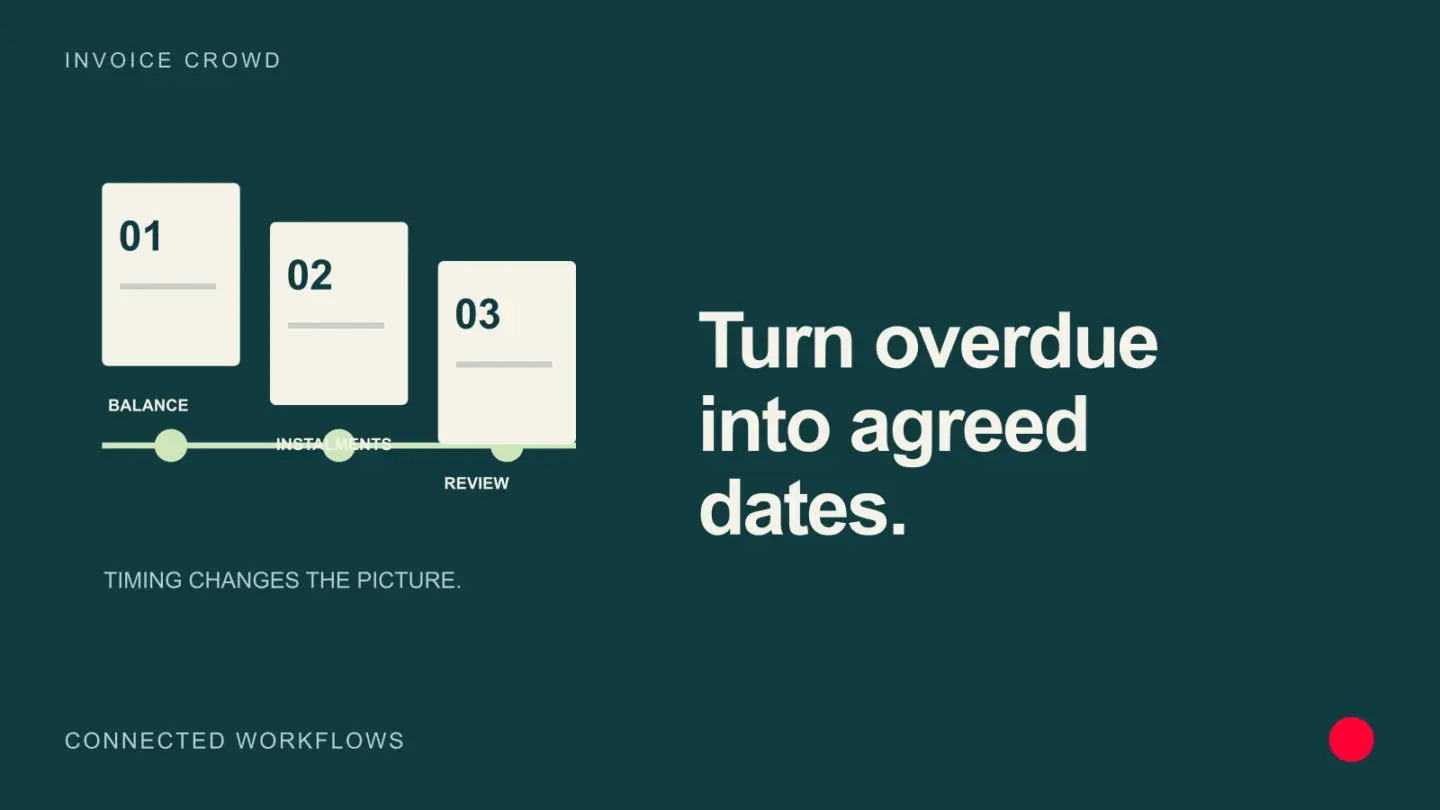
Brightline asked for $2,400 on signing and three monthly installments of $2,400. Each payment is applied to the oldest invoice first, so INV-1042 clears before INV-1057.
| Payment due date | Amount | Applied to | Balance after payment |
|---|---|---|---|
| December 1 | $2,400 | INV-1042 | $7,200 |
| January 5 | $2,400 | INV-1042 | $4,800 |
| February 5 | $2,400 | $1,200 to INV-1042, $1,200 to INV-1057 | $2,400 |
| March 5 | $2,400 | INV-1057 | $0 |
Brightline also agreed to waive late fees as long as every payment arrives within five days of its date. If a payment is more than 14 days late, the whole remaining balance becomes due and the fees come back. That clause gives the customer a reason to stay on schedule and gives you a clear point to escalate.
What to put in a payment plan agreement
Use this as your template. Every item answers a question that will otherwise come up at the worst moment.
- Customer legal name and all invoice numbers included.
- Original balance, credits, payments received, fees if lawful, and current balance.
- Each installment amount and payment due date.
- Payment method, the reference to quote, and how partial payments will be allocated.
- Whether ordinary service continues, pauses, or requires an upfront payment.
- What happens after a missed payment, subject to the contract and law.
- Authorized contacts, acceptance, and date.
Add one line stating that the agreement changes the payment schedule only and that the original invoice terms otherwise still apply. It helps preserve your rights under the original contract.
Overdue invoice email templates for a payment plan
Offering the plan
Subject: Invoices INV-1042 and INV-1057, a payment plan option
Hi Dana, thanks for calling about the overdue balance of $9,600. We can split it into four payments: $2,400 on December 1, then $2,400 on January 5, February 5 and March 5. Late fees are waived while each payment arrives within five days of its date. If this works, reply “agreed” and I will send the schedule and a payment link for the first installment.
Payment reminder email template for each installment
Subject: Payment 2 of 4 due January 5
Hi Dana, a quick reminder that the second payment of $2,400 under our plan is due on January 5. You can pay online with the link below, or by bank transfer quoting INV-1042. After this payment the remaining balance will be $4,800. Thank you for keeping the plan on track.
Send the installment reminder three days before each date, and a short receipt with the new balance once the payment arrives. Our late payment reminder sequence has wording for the stages before a plan is on the table.
Interest and late fees during the plan
Charge interest or a late fee only if your contract or invoice terms allow it and the law where you trade permits it. In the UK, the statutory interest rate on late business-to-business payments is 8% plus the Bank of England base rate, unless the contract sets a different rate. A business can also claim fixed debt recovery costs of £40, £70 or £100, depending on the size of the debt. In the US, what you can charge depends on your signed terms and your state’s law, so check both.
Many businesses waive late payment fees in exchange for a plan that runs on time, as Brightline did. The waiver is the incentive; reinstating the fees on default is the deterrent.
When a payment due date is missed
Act on the first missed date, not the third. A simple protocol:
- Day 1: a short email reminder with the payment link.
- Day 3: a phone call to the authorized contact.
- Day 14: written notice that the full balance is now due, as the agreement says.
- After that: a collection agency, a demand letter or small claims court, depending on the amount.
If the account will not be paid, treat the rest as bad debt and record the write-off properly.
Keep the unpaid invoice open in your books
Do not cancel the overdue invoices and issue new ones for each installment. That resets the invoice history, hides how long the money has been owed in accounts receivable and can tangle your sales tax or VAT records. A credit note is for amounts the customer no longer owes; our guide to credits, refunds and debit notes explains when each document applies. Record each received payment against the original invoice instead, as a partial payment.
In Invoice Crowd, Manage Payments lets you set an invoice to partial or split payments. With splits, the customer’s invoice page shows a payment schedule with each installment’s due date and a button to pay it, and each installment payment gets its own receipt. A switched-on late fee can be waived from the invoice when the plan includes that promise.
Frequently asked questions
How long should a payment plan be for an overdue invoice?
Three to six months suits most small business balances. Longer plans raise the risk that the customer’s situation gets worse before you are paid. Size the installments to what the customer can pay from normal cash flow, take a down payment, and if the plan fails, move to a collection agency or small claims without restarting negotiations.
Can I charge interest on an overdue invoice payment plan?
Only if your contract or invoice terms allow it and local law permits it. UK businesses can claim statutory interest of 8% plus the Bank of England base rate on late business-to-business payments. Many businesses waive interest while the plan runs on time and reinstate it if a payment is missed, which gives the customer a reason to keep to the schedule.
How do you respond when a client asks for a payment plan?
Thank them for raising it, confirm the exact overdue balance, and ask what they can pay and when. Then propose a schedule with a down payment and fixed dates, state what happens if a payment is missed, and ask for written acceptance. Send the first payment link the same day, while the commitment is fresh.
How do you ensure clients stick to a payment plan?
Make paying easy and missing visible. Send a reminder before every installment, include an online payment link, confirm each payment with the new balance, and call the day after a missed date. A down payment, a short schedule and a written default clause do most of the work before the first reminder is sent.
To send payment links, schedule reminders and track partial payments against each invoice, explore Invoice Crowd customer invoicing.