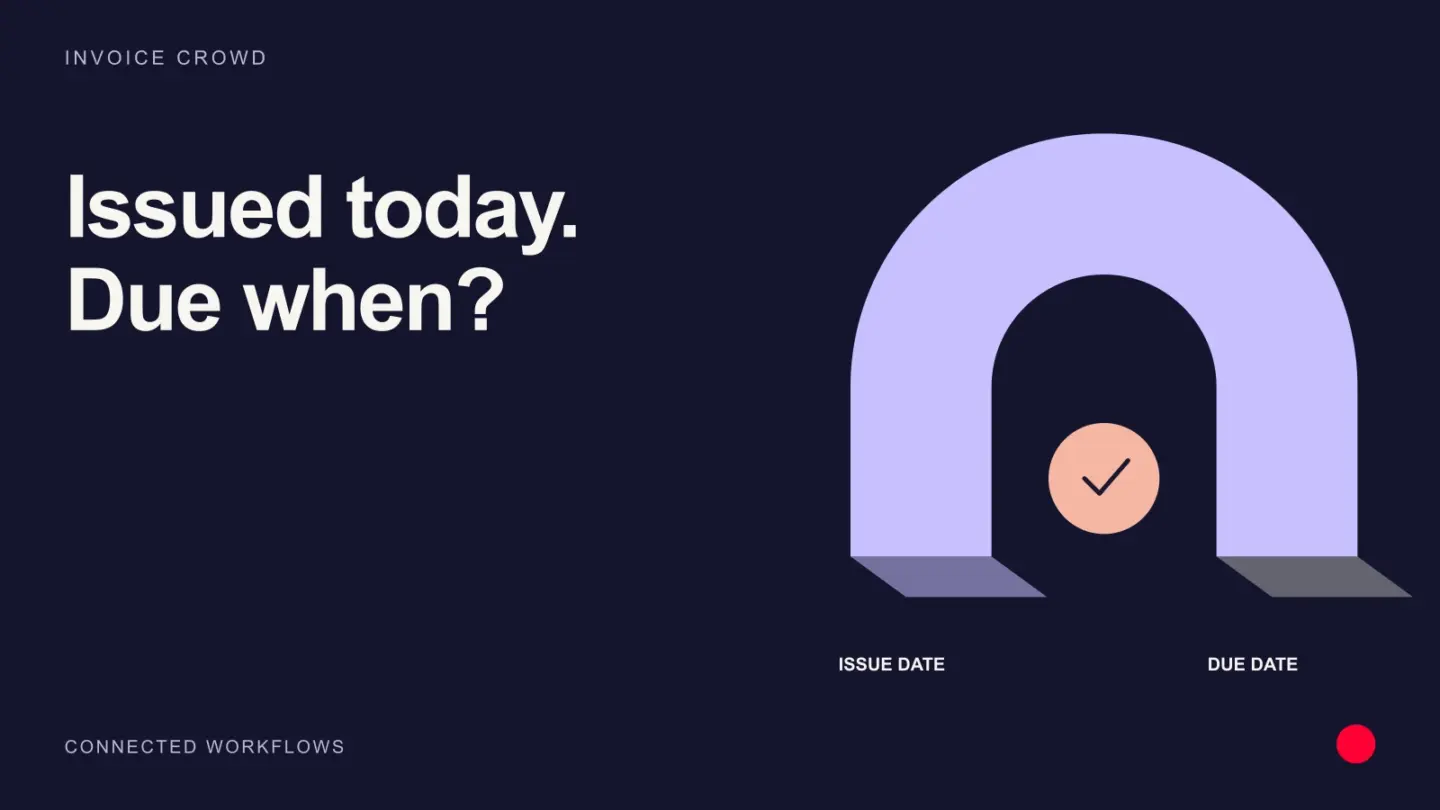
The invoice date is the day an invoice is issued. The due date is the deadline for payment under the agreed payment terms. For example, an invoice issued on 5 August with Net 30 terms from the invoice date is due on 4 September, when the agreement counts 30 calendar days after issue.
Print both dates. Before calculating the deadline, check whether the contract or accepted quote starts the payment period on issue, receipt, delivery or acceptance.
Invoice date vs due date: the key differences
| Date | What it tells you | Example |
|---|---|---|
| Invoice date (issue date) | When the seller issued the payment request | 5 August 2026 |
| Invoice due date | When the customer must pay under the agreed terms | 4 September 2026 for Net 30 from issue |
| Supply or service date | When the goods or services were provided | 31 July 2026 |
| Payment date | When payment actually occurs, using the definition in your records or agreement | 2 September 2026 if the customer pays early |
These dates can be different. The issue date is not automatically the tax point or the date revenue should be recognized. Tax and accounting treatment depends on the applicable rules. For example, UK government invoice guidance lists the supply date and invoice date separately.
How to calculate an invoice due date
- Find the agreed starting event. Read the contract, purchase order or accepted quote. Do the terms run from invoice issue, receipt or approval?
- Check the number of days and counting rules. Net 15, Net 30 and Net 60 describe the payment period. Confirm calendar versus business days and any weekend or holiday rule.
- Add that period to the starting date. Under terms of 30 calendar days after 5 August, the deadline is 4 September. One calendar month after 5 August is 5 September, so the two are not interchangeable.
- Print the result clearly. Use wording such as “Invoice date: 5 August 2026. Payment due: 4 September 2026. Terms: Net 30 from invoice date.”
If the starting event is not yet known, record it when it occurs and confirm the calculated deadline with the client. Do not assume that a buyer’s internal approval delay changes the terms you already agreed.
Payment terms and due date examples
| Agreed terms | Starting event | Payment deadline |
|---|---|---|
| Net 15 from issue | Invoice issued 5 August | 20 August, counting 15 calendar days after issue |
| Net 30 from issue | Invoice issued 5 August | 4 September, counting 30 calendar days after issue |
| Net 15 from acceptance | Acceptance documented on 10 August | 25 August, even if the invoice was issued earlier |
| Due upon receipt | Customer receives the invoice on 7 August | Payment is due on receipt under those terms, not automatically on the issue date |
| End of the month | The agreement specifies the end of August | 31 August; spell out the month rather than relying on shorthand |
| Deposit before work | The agreed project start | The stated deposit deadline before work begins |
These examples assume the stated counting rules and no separate holiday adjustment. For a deposit, also state the amount and how nonpayment affects scheduling. For an early payment discount, show its deadline separately from the final due date.
Which date controls overdue payments and aging?
For collection follow-up, compare today’s date with the agreed payment deadline. An invoice can be outstanding without being overdue. If it is issued on 5 August and due on 4 September, it is still within terms on 20 August.
Check how your aging report works: some reports age balances from the invoice date, while others use the due date. Invoice age and days overdue answer different questions. Use the appropriate measure when planning cash flow or sending a reminder.
If the deadline passes, first check for a payment in transit, a missing invoice or a dispute. Send a clear reminder with the invoice number, unpaid balance and original due date. Only charge late fees or interest where the agreement and applicable law allow them.
What if the invoice date or due date is wrong?
Correct the error promptly and tell the customer what changed. Keep the original record and an audit trail. If an invoice needs to be reissued, follow the correction rules that apply to your business rather than silently overwriting dates.
Do not backdate an invoice or reset its deadline just to make an aging report look better. An agreed extension should be recorded with the new payment commitment and the reason for it. Confirm whether a correction changes the deadline instead of assuming it restarts the payment clock.
Frequently asked questions
Are the invoice date and due date ever the same?
Yes. They can match when payment is due immediately and the invoice is received on the day it is issued. Otherwise, use the agreed payment terms to calculate the deadline.
Does Net 30 always start from the invoice date?
No. Net 30 describes a 30-day payment period, but the agreement determines its starting point. Terms may specify receipt, delivery or acceptance instead of issue. State the starting event and the actual due date to avoid a counting dispute.
Is the invoice date the same as the billing date?
Billing date often means the invoice issue date. In recurring billing, it may refer to a billing-cycle date. Check the label used by your system and do not confuse either with the payment deadline.
How long should I give a customer to pay?
Choose terms before the sale using your cash needs, customer risk, industry practice and bargaining position. A deposit or shorter terms may suit a small project; a longer B2B payment cycle needs enough cash to cover the wait. There is no universal deadline for every invoice or country. Check local rules if no payment date was agreed.
Make the payment request easy to act on
Before sending, check the customer details, invoice number, amount and currency, issue date, payment deadline and payment instructions. Make sure the dates match the agreed terms. Read our guide to purchase orders, invoices and bills for the related workflow.