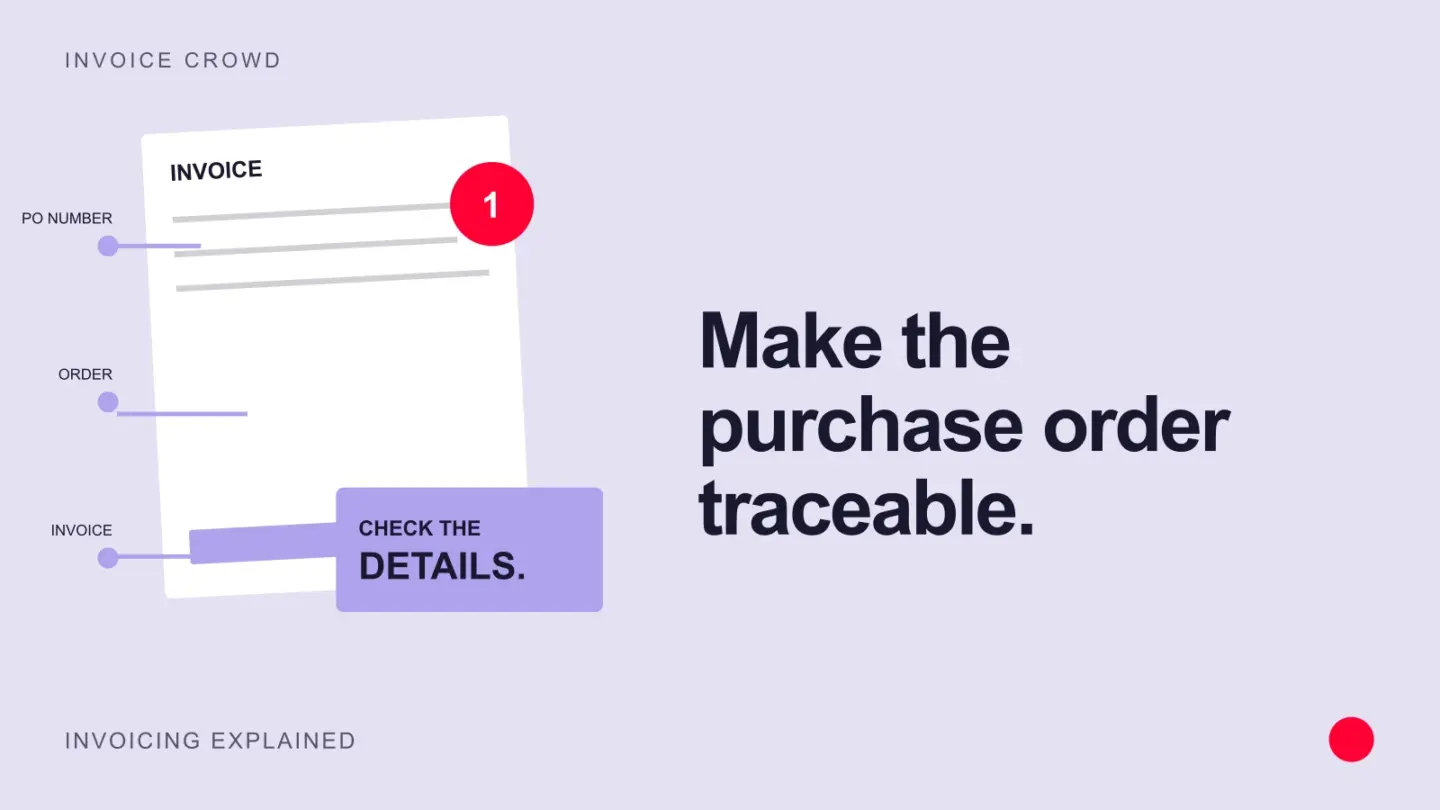
A PO number on an invoice is the buyer’s purchase order reference. It links your payment request to the order the buyer approved. Copy it exactly into a field labeled “PO number” or “Purchase order number,” usually near your invoice number and dates.
Keep your own invoice number as well. The two references identify different documents and help accounts payable match the right order to the right bill.
What is a purchase order number?
A purchase order number is a unique identifier within the buyer’s purchasing system. The buyer assigns it when they create a purchase order for goods or services. You receive that order as the supplier and reference it when you bill for the approved work.
The PO number helps the buyer locate the order details, check the budget and connect the invoice with receiving or acceptance records. It does not, by itself, prove that delivery happened or that the amount billed is correct.
PO number vs invoice number: what is the difference?
| Reference | Created by | Identifies | Example |
|---|---|---|---|
| Purchase order number | Buyer | The approved order | PO-2027-00842 |
| Invoice number | Seller | The issued invoice | IC-2027-0146 |
| Supplier or vendor number | Buyer | The seller in the buyer’s system | V-10492 |
| Receipt reference | Buyer | The goods or services received or accepted | GRN-6631 |
A buyer can use one purchase order for several approved deliveries or milestones. Each invoice still needs its own invoice number. Do not overwrite that number with the customer’s PO reference or reuse an old PO for work outside its scope.
Where the PO number goes on an invoice
Put the PO number in a dedicated buyer-reference field near the invoice number, issue date and payment due date. Use a clear label so a person or invoice-processing system can distinguish it from your internal reference.
For example, a milestone invoice might show:
- Invoice number: IC-0146
- Invoice date: 5 August 2026
- Payment due: 4 September 2026, under agreed Net 30 terms
- Customer PO number: PO-7842
- Description: Design services, milestone 1, against the relevant PO line
These are illustrative details, not a complete invoice template. Include the customer and supplier information, line items, amounts, tax details where applicable, and payment instructions required for your transaction.
For a customer portal or electronic invoice, also complete the designated purchase-order reference field. A number visible in the PDF may not populate that field automatically. Follow the buyer’s submission rules, including any required PO line reference.
How to find the correct PO number
- Check the approved purchase order. Use the document or buyer portal, not an unrelated quote, sales order or email subject line.
- Confirm the order covers your invoice. Check the supplier, description, quantity, price, currency and remaining approved value.
- Copy the reference exactly. Preserve letters, leading zeros and separators unless the buyer’s submission instructions say otherwise.
- Ask the buyer if anything is unclear. Contact the person who placed the order or the purchasing team before submitting the invoice.
There is no single PO number format used by every business. A buyer may use a sequential number or a code containing a year or department. If you are the supplier, do not create a PO number for your customer or guess one from a previous order.
Do all invoices need a PO number?
No. Some customers do not use purchase orders, and others allow specified non-PO expenses. Whether you need the reference depends on the buyer’s procurement process, your agreement and any applicable requirements. Ask before work starts rather than waiting until payment is due.
Some buyers operate a “No PO, No Pay” policy. For example, the UK Department for Work and Pensions policy requires a valid DWP purchase order number on supplier invoices unless an exception applies. That is a specific buyer policy, not a universal rule for every invoice.
What should you do if the PO is missing or incorrect?
- No PO received: Ask the buyer to resend the approved order and confirm its reference.
- Work was authorized without a PO: Request the documented non-PO or exception process. Keep the written authorization with your billing records.
- The amount or scope has changed: Ask the buyer to amend the order or issue the required approval before billing the extra work.
- The PO is closed or exhausted: Confirm which approved reference should cover the remaining work. Do not substitute an unrelated open order.
- The invoice was rejected: Obtain the reason, correct the specific mismatch and follow the buyer’s resubmission process without creating an accidental duplicate.
A missing PO can delay processing, but it does not settle whether a debt is legally owed. For a payment dispute, review the agreement and seek appropriate advice rather than assuming an administrative rejection cancels the obligation.
How PO numbers support invoice matching
Two-way matching compares the purchase order and invoice. Three-way matching also checks the goods receipt or service-acceptance record. The reference helps accounts payable find those documents; the checks establish whether the supplier, quantities and prices agree.
A correct reference can reduce manual searching, but it cannot resolve every discrepancy. A quantity difference, price change, tax error or missing acceptance may still need review under the buyer’s tolerance and approval rules.
Frequently asked questions
Can the same PO number appear on more than one invoice?
Yes, if the order permits multiple deliveries or milestone invoices. For example, PO-7842 can appear on each approved design milestone, while every invoice has a different invoice number. Track the cumulative amount against the order so you do not exceed its scope or value.
Can one invoice include several PO numbers?
Only if the buyer accepts that format. Some require a separate invoice for each purchase order; others accept line-level references. Confirm the rule before combining orders. DWP, for example, lists multiple PO numbers on one invoice as a reason for a dispute.
Is a PO number the same as an order number?
Not always. A supplier’s sales order number and the buyer’s purchase order number may be different. Use the exact reference the customer identifies as their PO number.
Does a PO number guarantee payment?
No. It identifies the approved order. Payment can still depend on delivery, acceptance, accurate billing and the agreed terms. Keep the supporting records as well as the reference.
Check the references before sending
Confirm that your invoice number is unique, the PO number matches the approved order, the line items are within scope and the submission fields are complete. Read our guide to purchase orders, invoices and bills for the wider workflow. Explore Invoice Crowd invoicing to see how it fits the way you bill.