Tweedside Weavers, a 20-person mill in the Scottish Borders, ships 260 wool blankets and throws to a homeware store in Portland, Oregon. The order is worth $21,535 delivered. Four days later the customs broker emails: the shipment is on hold, because the paperwork says “wool textiles, 260 pcs” and nothing about origin, freight or what each item is.
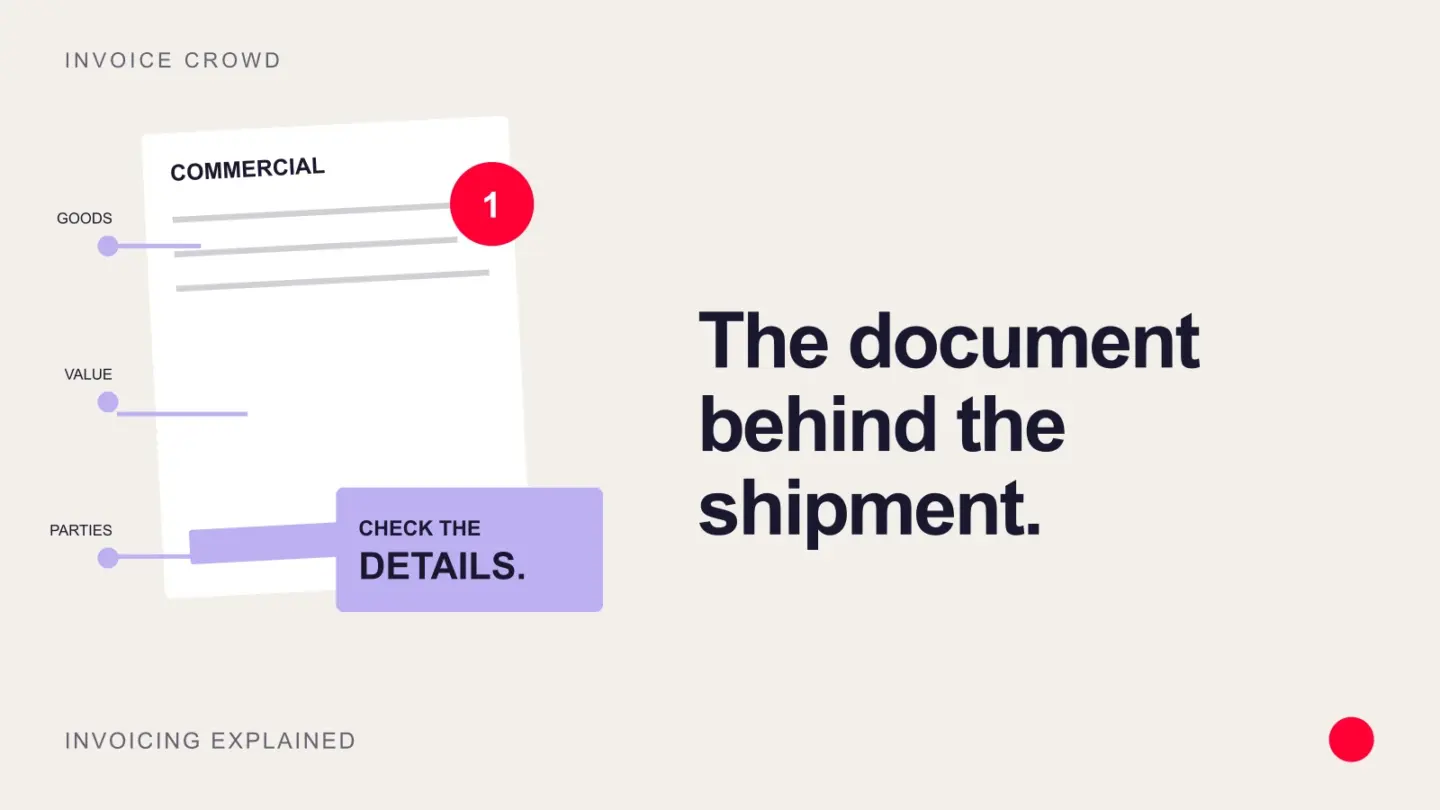
A commercial invoice is the seller’s invoice for an international shipment. Customs uses it to identify the parties, the goods, their value, their origin and the terms of trade, and to calculate duties and taxes. The exporter normally prepares it, and it travels with the goods.
What is a commercial invoice for shipping in international trade?
A domestic bill asks a customer to pay. A commercial invoice does that and also tells two governments what crossed the border. The U.S. International Trade Administration calls it “a required document for the export and import clearance process,” used by customs officials in the buyer’s country to assess import duties and taxes (ITA: commercial invoice).
A commercial invoice serves several parties involved in a cross-border sale. The importer’s broker uses it to file the customs declaration. A bank paying under a letter of credit checks it against the credit’s terms. The buyer books it as the purchase. Each reads it for a different reason, so one vague line can hold up international shipments at every step.
Commercial invoice vs proforma invoice, packing lists and domestic invoices
| Document | When it is issued | What it is for |
|---|---|---|
| Pro forma invoice | Before shipment | Lets the buyer arrange payment, an import license or approval |
| Commercial invoice | At shipment | Records the sale and gives customs what it needs to clear and value the goods |
| Packing list | At shipment | Shows what is in each package, with weights and dimensions, but no prices |
| Domestic invoice | After a sale at home | Requests payment; carries no origin, tariff or shipping data |
The proforma often becomes the draft for the final document, so read what a pro forma invoice is if the buyer asked for one first. If the sale also carries VAT or GST, the tax invoice rules apply on top.
What a commercial invoice must include for customs clearance
Requirements depend on the destination, but most trade documents ask for the same core information. For goods entering the United States, U.S. Customs and Border Protection lists the contents in 19 CFR 141.86. For a commercial invoice for export from the UK, the government’s guidance lists what to put on an export invoice.
| Field | What to enter | Required by |
|---|---|---|
| Seller and buyer | Full name, address and contact details of each party, plus the final recipient if different | CBP and UK guidance |
| Number and date | Document number and date, plus references to the order or proforma | UK guidance; CBP asks for the time of sale |
| Port of entry | Where the goods will enter the destination country | CBP |
| Description of goods | The name each item is known by, its grade or quality, and package marks and numbers | CBP and UK guidance |
| Quantity and weight | Quantities in the units of the exporting country or the United States | CBP and UK guidance |
| Price and currency | Purchase price of each item in the currency of the purchase | CBP and UK guidance |
| Charges | Freight, insurance, commissions and packing, itemized by name and amount | CBP; UK says list freight and insurance separately |
| Country of origin | Where the goods were made | CBP and UK guidance |
| Assists | Dies, molds, tools or engineering work the buyer supplied that the price leaves out | CBP |
| HS code and Incoterms | Tariff classification and the agreed terms of sale | UK guidance |
CBP also requires the document and all attachments to be in English or to carry an accurate English translation. In the UK, the completed paperwork must travel with the goods, and you must keep commercial invoices and customs records (GOV.UK: export goods).
Is an HS code required on a commercial invoice for export?
The Harmonized System is the World Customs Organization’s product nomenclature. Each commodity group has a six-digit code, the system is used by more than 200 countries and economies, and over 98% of merchandise in international trade is classified under it (WCO). National tariffs add digits. In the U.S. Harmonized Tariff Schedule, wool blankets fall under 6301.20.00, and those not over 3 meters long under 6301.20.00.10 (USITC).
Whether the code must appear depends on who is asking. CBP’s rule does not list it, and the ITA says the document “may include” it. The UK guidance includes it and warns that tax and duties vary by classification number. Since the HS code drives the tariff, include it whenever you know it, and confirm it rather than copying the closest match from an old shipment.
Completing a commercial invoice: a step-by-step shipment example
Here is the version Tweedside should have sent, INV-3310, dated 9 November 2026 and priced in U.S. dollars because the buyer agreed to pay in dollars.
| Description | HS code | Qty | Unit price | Amount |
|---|---|---|---|---|
| Throw, 100% lambswool, woven, 130 x 180 cm | 6301.20 | 200 | $58.00 | $11,600.00 |
| Blanket, 100% merino wool, woven, 230 x 250 cm | 6301.20 | 60 | $145.00 | $8,700.00 |
| Air freight to Portland | $1,150.00 | |||
| Cargo insurance | $85.00 | |||
| Total value, CIP Portland, Oregon (Incoterms 2020) | $21,535.00 |
- Parties. Tweedside’s full name and address as exporter; the Portland store as buyer and consignee, with a contact name.
- References. The buyer’s purchase order number, so the broker can match the shipment to the order. See PO numbers on invoices.
- Goods. Fiber, construction and size on each line, so an officer can classify the item without asking.
- Value. The goods total of $20,300, with freight and insurance on their own lines.
- Origin and transport. Country of origin United Kingdom, port of entry Portland, 14 cartons, 236 kg gross, and the air waybill number.
- Terms. The Incoterm and named place, plus payment terms of 30 days.
Then double-check the information on the invoice against the packing list: 200 plus 60 is 260 pieces, the same count the carrier will see.
Common mistakes in invoice preparation that cause customs delays
- Vague descriptions. “Textiles” or “parts” tells customs nothing. Say what the item is, what it is made of and what it is for.
- Freight buried in the price. CBP wants charges itemized, and the UK asks you to list freight and insurance separately.
- A zero value on samples. Goods sent free still need a value for customs purposes. The UK says to use market value if you are not selling them, and CBP asks for the price they would fetch in the ordinary course of trade.
- Paperwork that disagrees. Any discrepancy between quantities or weights on the two documents invites an inspection.
- The wrong currency. State the currency of the sale. For your own books, our guide to which exchange rate to use covers the choice.
Errors can lead to more than delays: the duty is calculated from what you declare. For unusual goods, take professional advice from a customs broker before the first shipment.
Invoice templates or software for accurate commercial invoices
A carrier’s template works if you ship goods overseas a few times a year. Once you ship every week, keeping each document consistent with the order and the packing list matters more than the layout.
In Invoice Crowd, each invoice can carry its own currency and a Ship To address, and custom fields placed above or below the items can hold details such as the Incoterm or the port of entry. Shipping appears as its own line in the totals, and a delivery note can be downloaded from the same sales invoice. Standard captions can print in one of eight languages when the buyer needs another language version. For selling across borders in general, see our multi-currency invoicing guide.
Frequently asked questions
Who fills out a commercial invoice?
The exporter, meaning the seller, normally prepares it. The ITA notes that for most countries the seller’s or exporter’s version is acceptable. The importer, broker or carrier may ask for extra details, and a freight forwarder can help you create a commercial invoice the first time.
Does a commercial invoice need to be signed?
CBP’s list of required contents for U.S. imports does not include a signature. Some destination countries, banks working under a letter of credit and carriers do ask for a signed declaration, so check the buyer’s instructions and the carrier’s requirements before the goods leave.
What is the difference between a commercial invoice and a regular invoice?
A regular invoice asks for payment. Unlike domestic invoices, a commercial invoice also carries what customs needs: the country of origin, a detailed description of goods, the HS code, the Incoterm, itemized freight and insurance, the port of entry and package details.
What currency should a commercial invoice use?
Use the currency of the sale. For U.S. imports, 19 CFR 141.86 asks for the purchase price of each item in the currency of the purchase. If the contract was priced in pounds, bill in pounds rather than converting prices into the buyer’s currency yourself.
Read our guide to purchase orders, invoices and bills for the related workflow. Explore Invoice Crowd invoicing to see how it fits the way you bill.