Marta runs a three-person garden design studio. In a quarterly review her accountant finds two invoices numbered 0142, one to a homeowner for $2,400 and one to a property manager for $860, plus a jump from 0157 to 0163 that nobody can explain. The property manager quoted “0142” on its bank transfer, so the $860 landed against the wrong invoice and the homeowner received a reminder for a bill she had already paid.
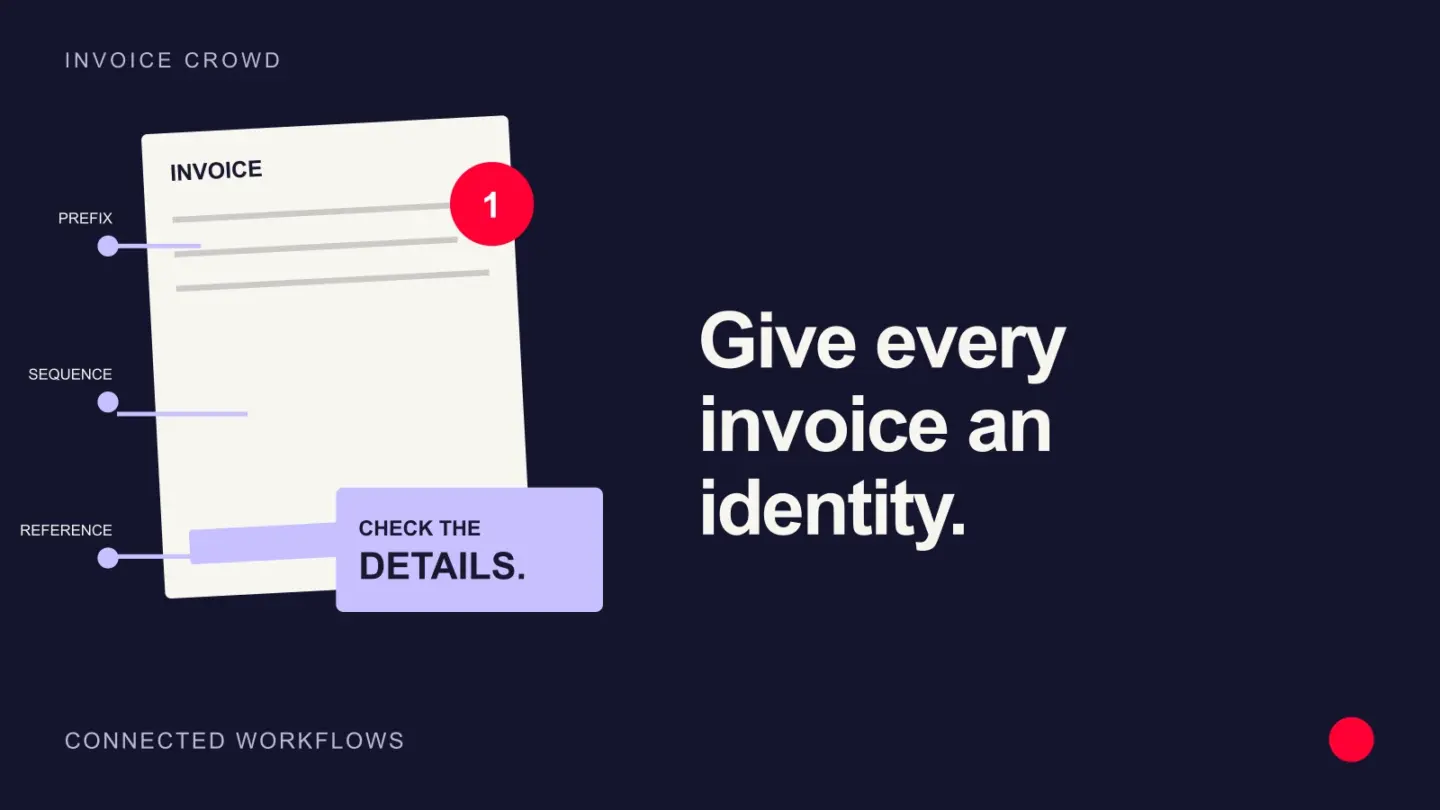
An invoice number is a unique identifier assigned to each invoice in a sequence that never repeats. For most small businesses the best invoice numbering system is a short prefix plus a zero-padded sequential number, such as INV-00142, assigned when the invoice is issued and never reused, even after a cancellation.
What an invoice number is, and why businesses use invoice numbers
An invoice number is a unique code that tells one invoice from another, so anyone can find a specific invoice without opening the PDF. It sits near the top of the invoice, beside the invoice date, and everyone uses it afterwards: your customer’s invoice processing team, your bookkeeping and bank reconciliation, your accountant and, if it comes to it, a tax inspector.
A unique invoice number helps in four ways:
- Payment matching. Customers quote the invoice number on a transfer, so a unique number puts the payment on the correct invoice.
- Tracking. You can find any outstanding invoice in seconds.
- Audit trail. A reviewer can confirm that every invoice number issued appears in your accounting records, with no duplicates and no unexplained gaps.
- Fraud control. A broken sequence is often the first sign of a duplicate bill or a fake invoice in the books.
An invoice number is not the same as a purchase order number. The customer creates the PO number before buying; you create the invoice number when you bill. Many customers need both on the invoice, as our guide to the PO number on an invoice explains.
What is the rule for invoice numbers?
For VAT invoices in the EU, Article 226(2) of the VAT Directive requires “a sequential number, based on one or more series, which uniquely identifies the invoice.” The European Commission’s explanatory notes on the invoicing rules add that the series may include alphanumeric characters, and that a business may choose separate series for each branch, type of supply or customer.
In the UK, the invoice number must be unique: GOV.UK lists “a unique identification number” among the details every invoice must include. For VAT invoices, HMRC’s VAT trader records manual asks for a sequential number in a series, which may mix letters and numbers. It allows more than one sequence at the same time, a first invoice that starts above 1 as long as the series runs consecutively from there, and cancelled invoices kept in your records to explain a break.
Other countries set their own rules, and some add requirements of their own, so check with your tax authority before you design an invoice number format for a new market.
Invoice number format examples: five ways to assign invoice numbers
| Invoice numbering method | Example | Best use | Watch for |
|---|---|---|---|
| Simple sequential | INV-00142 | One business, one sales series | No date context in the number |
| Year plus sequence | INV-2026-0142 | Annual reporting and archiving | Decide whether the sequence resets |
| Branch or entity series | NYC-INV-00842 | Separate locations or legal entities | Every branch needs its own counter |
| Customer series | ACME-007 | A few large accounts billed often | Hard to audit across customers |
| Project series | P118-03 | Agencies billing in milestones | Still needs a unique company-wide number |
The first two cover most small businesses, because they produce sequential invoice numbers that are easy to check. Customer and project series tell a story, but a reviewer has to look across dozens of mini-series to confirm nothing is missing. If you want the customer or project on the invoice, put it in a reference field and keep the invoice number itself sequential.
How to create an effective invoice numbering system
Set up the invoice number system once, before you create an invoice number for your first client.
- Pick a short prefix. INV for sales invoices. Alphanumeric invoice numbers are fine, but keep letters to the prefix so the sequence stays easy to sort.
- Pad the invoice number. Five digits (00001) sort correctly in spreadsheets and leave room for 99,999 invoices.
- Choose a first invoice number. Start at INV-00001 or higher, such as INV-01001. HMRC’s guidance accepts starting with a higher number as long as the series then runs consecutively.
- Give other documents their own series. CN for credit notes, EST for estimates, PO for purchase orders, PF for pro forma invoices. A pro forma invoice is a preview of a sale, so it should never consume a number in the invoice sequence.
- Write the numbering rules down. Record the prefix, padding, reset rule and how voided invoices are kept. One page saves an argument with a future bookkeeper.
Should the first invoice of each year restart the sequence?
Either approach can work if the year is part of the number. If INV-2026-0001 follows INV-2025-1842, every number is still unique and the reset is visible. If the year is not in the number, resetting to INV-0001 creates duplicate invoice numbers, which is Marta’s problem.
A continuous sequence is simpler and never needs a decision in January. A yearly series helps businesses that archive by financial year. Choose once and keep it, because switching formats makes old financial records harder to search.
How to correct invoice number mistakes
Never renumber later invoices to close a gap or hide a duplicate. Fix the record forward instead:
- Duplicate number. Keep the earlier invoice. Void the second one, issue it again under the next free number and tell the customer which invoice number to quote.
- Gap in the sequence. Find the missing number. If it was a cancelled or spoiled invoice, keep it marked void with its date and reason. Gaps are not wrong in themselves; unexplained gaps are.
- A typo or wrong details on a sent invoice. Do not edit the invoice number. Issue a credit note against the original and a new invoice, or follow the correction steps in our guide to correcting an invoice mistake.
For Marta, that means keeping the $2,400 invoice as 0142 and reissuing the $860 one as 0164, the next free number. The 0158 to 0162 gap turned out to be five drafts deleted after a client cancelled, which she now notes in a short void log.
Invoice numbering best practices for small businesses
- Decide what happens to numbered drafts. Abandoned drafts are a common cause of gaps, so note why each one was dropped.
- Keep the number neutral. Leave out customer names, amounts and staff initials.
- Think about what the number reveals. INV-00007 tells a new client they are one of your first. Starting at a higher number or using a yearly series hides your volume.
- Use one invoicing system. As the business grows, two people who number invoices in separate spreadsheets will eventually produce duplicates.
- Ask customers to reference the invoice number. Put “Please reference invoice INV-00142” next to your bank details, as described in our guide to the bank transfer reference.
Two different suppliers can issue the same invoice number, because it only has to be unique within each seller’s series. Your customer’s accounts payable team tells them apart by supplier name.
Automate invoice numbering in your invoicing system
Manual invoice numbering works for the first dozen invoices. After that, let software assign the next number, so every invoice you send continues the invoice number sequence, even when several people are billing.
In Invoice Crowd, the invoice workflow numbers sales invoices from INV- with zero-padding, while estimates, credit notes, bills and purchase orders keep their own series. A new invoice gets its number when it is first saved. To start a new format, type a different number, prefix included, on a new invoice, and the invoices after it continue from that number; a number already in use is refused. A sent invoice can be voided, which keeps its number on the record.
Frequently asked questions
Can invoice numbers contain letters and numbers?
Yes. The EU explanatory notes and HMRC both accept alphanumeric invoice numbers, as long as each one is part of a unique, sequential series. Keep letters to a fixed prefix, such as INV or CN, so the running number still sorts in order and gaps are easy to spot.
Can invoice numbers restart each year?
Only if the year is part of the number, so the new series cannot duplicate an old one. INV-2027-0001 after INV-2026-1842 stays unique; INV-0001 for the second time does not.
Can I change an invoice number after issuing it?
No. Once the invoice is sent, the number belongs to that document. If it is wrong, void or credit the original and issue a new invoice under the next number, then tell the customer which number to quote when paying.
Do proforma invoices need a unique invoice number?
Give them a unique reference from a separate series, such as PF-00012, so they can be tracked. Keep them out of the sales invoice sequence: a pro forma is not the final bill, and the real invoice gets its own number when the sale happens.