Ridgeline HVAC sent a property manager a $6,400 invoice marked “Payment terms: Net 30.” The manager’s accounts payable team counted 30 days from the date they approved the invoice, not the date it was sent, and paid on day 41. Nobody broke the agreement. The wording never said when the 30 days started.
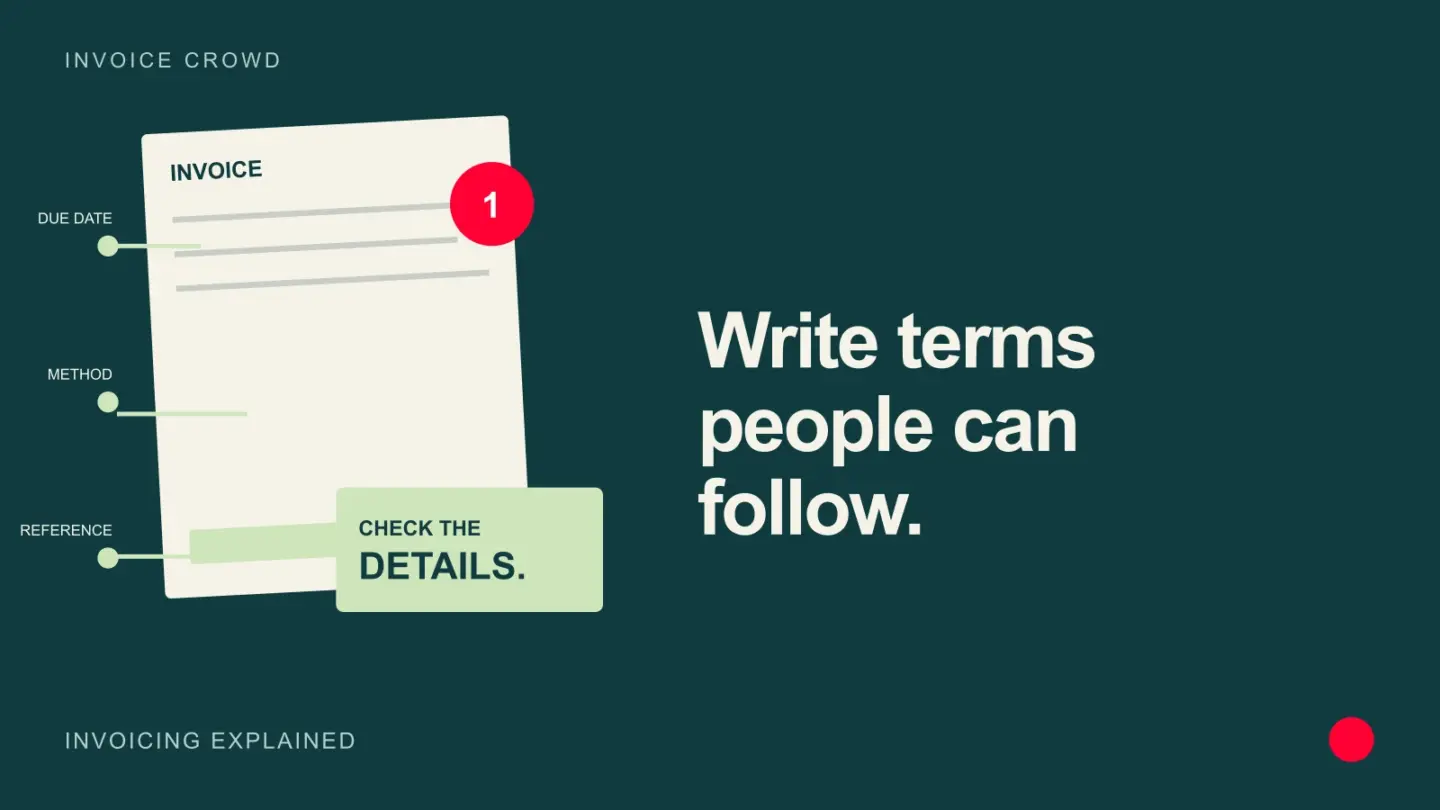
Clear invoice payment terms state the amount due, the payment deadline, accepted payment methods and the reference to use. Start with: “Payment of [amount] is due by [date]. Please pay by [method] and quote invoice [number].” Add only the deposit, discount or late payment conditions that the customer already agreed to.
What to include in your payment terms
- Amount due: the balance after credits or deposits, with the currency for international customers.
- Payment due date: an exact date next to shorthand such as Net 30, so nobody has to count days.
- Starting event: whether the period runs from the invoice date, receipt, delivery or acceptance.
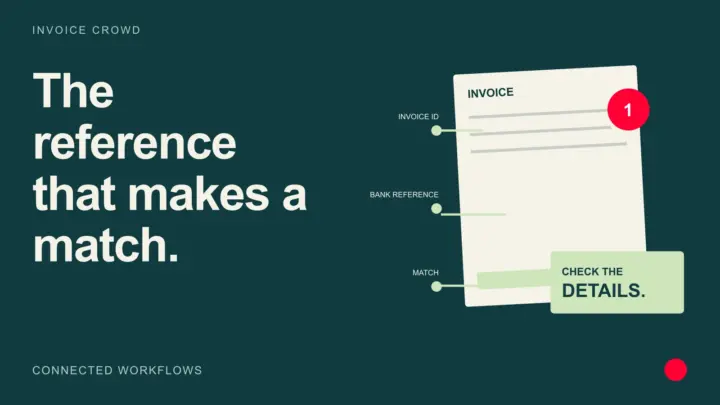
- Payment method and reference: how to pay and which invoice number to quote.
- Conditions: agreed deposits, installments, early payment discounts or late payment fees.
- Billing contact: who to ask before a question turns into an unpaid invoice.
Put the terms beside the total or in a labeled payment section, never only in the email.
Types of payment terms and how they work
These common payment terms cover most business-to-business invoices, and each has matching wording below.
| Term | What it means |
|---|---|
| Due upon receipt | Immediate payment when the invoice arrives |
| Net 7, Net 14, Net 15 | Payment due within 7, 14 or 15 days of the invoice date |
| Net 30 | Payment is due 30 days after the invoice date |
| Net 60, Net 90 | 60 or 90 days; often a procurement rule at large companies |
| EOM | Due at the end of the month the invoice is issued |
| Net 15 EOM | Due 15 days after the end of the invoice month |
| 2/10 Net 30 | 2% off if customers pay within 10 days, full amount due in 30 |
| CIA or CWO | Cash in advance, or cash with order |
| COD | Cash on delivery |
| Deposit and balance | Part upfront, the remainder on completion |
“Net 30” alone leaves the starting event open, which cost Ridgeline 11 days. See our invoice date vs due date guide, and for choosing between the shorter terms, Net 30, Net 15 and due on receipt.
25 invoice payment terms wording examples
Replace each bracketed field. Most invoices need two or three of these.
Due dates and net terms
- Exact due date: “Full payment of [amount] is due by [date].”
- Net 30: “Payment is due 30 calendar days after the invoice date of [issue date], by [due date].”
- Net 15: “Payment is due within 15 calendar days of the invoice date, by [due date].”
- Due upon receipt: “Payment is due on receipt of this invoice. Please pay by [method].”
Deposits, installments and recurring payments
- Deposit before work: “The agreed 30% deposit of [amount] is due by [date], before work is scheduled.”
- Remaining balance: “The remaining 70% of [amount] is due 7 days after written acceptance, by [date].”
- Milestone payment: “Milestone [number], [description], was completed on [date]. The agreed payment of [amount] is due by [date].”
- Retainer: “The retainer of [amount] for [service period] is payable in advance by [date].”
- Recurring service: “Payment of [amount] for [service period] is due on [date]. We bill [monthly/quarterly].”
- Installment plan: “This is installment [number] of [total]. Payment of [amount] is due by [date], leaving [remaining balance].”
On large or custom projects, require partial payment upfront and name the percentage, amount and deadline (see invoicing a deposit before work starts). A recurring invoice does not by itself authorize an automatic card or bank debit.
Discounts, payment methods and references
- Early payment discount: “Take 2% off if payment is received within 10 days, by [date]: pay [discounted amount]. Otherwise [full amount] is due by [date].”
- Bank transfer: “Please pay by bank transfer to the account on this invoice and quote invoice [number] as the reference.”
- Credit card: “You can pay by credit card through the secure payment link on this invoice.”
- Currency and charges: “Payment is due in [currency]. Bank charges are paid by [the payer/each party] under section [number] of our agreement.”
- Purchase order reference: “Please quote invoice [number] and PO [number] with your remittance.”
On Ridgeline’s $6,400 invoice, 2/10 Net 30 means a $128 discount: $6,272 by August 15, or $6,400 by September 4. Our 2/10 Net 30 guide shows when a small discount for early payment is worth its cost.
Questions, late payment and collection wording
- Billing question: “If any part of this invoice looks wrong, contact [billing contact] with the invoice number, the line and the reason.”
- Undisputed amount: “If you query part of this invoice, please pay the undisputed [amount] by [date] while we resolve the rest.”
- Late payment fee: “Invoices unpaid after [due date] incur a late fee of [amount or percentage], as agreed in section [number] of our terms of service.”
- Interest: “Overdue balances accrue interest at [rate] per month from the due date, as set out in our agreement.”
- Collection costs: “Reasonable costs of recovering an overdue balance will be charged where our agreement and the law allow.”
Acceptance, delivery and confirmation
- Payment after acceptance: “Payment is due 15 calendar days after written acceptance. Accepted: [date]. Due: [date].”
- Payment after delivery: “Payment is due [number] days after delivery to [location]. Delivered: [date]. Due: [date].”
- International transfer: “Please email remittance advice to [billing contact] on the transfer date, quoting invoice [number].”
- Check payment: “Please write invoice [number] on your check. Payment must be received by [date].”
- Credit applied: “Credit note [number] for [amount] has been applied. The remaining [amount] is due by [date].”
A complete example of payment terms on an invoice
Here is how Ridgeline rewrote the terms for invoice RH-1048, issued August 5, 2026, under agreed Net 30 terms:
Payment of $6,400 is due by September 4, 2026, 30 calendar days after the invoice date. Pay by bank transfer to the account below or by card through the payment link, and quote RH-1048. Take 2% off ($6,272) if paid by August 15. Questions: [email protected].
How to choose payment terms that protect cash flow
Payment terms decide how much of your cash flow you lend to customers. If Ridgeline bills $40,000 a month on Net 30, roughly $40,000 is always waiting to be collected. On Net 60, the same sales leave about $80,000 outstanding, money the business owner has to cover from savings or credit.
Net 7 or due on receipt suits one-off jobs and small balances. Net 30 is what most business customers expect. Net 60 or 90 is often non-negotiable for large buyers, so price it in or ask for a deposit. Deposits and milestones protect you on long projects where materials or hours come first.
Agree the terms in the quote or contract before work begins, then put the payment terms on every invoice. A condition printed for the first time on an invoice is weak evidence that the customer accepted it.
Late payment terms and conditions: what the law allows
You can usually charge a late fee or interest only if the contract provides for it, and the rules differ by country:
- UK: for business-to-business debts, statutory interest is 8% plus the Bank of England base rate, plus fixed recovery costs of £40, £70 or £100 depending on the debt, unless the contract sets a different rate (GOV.UK late commercial payments). With no agreed date, payment is late 30 days after the customer receives the invoice or the goods or service, whichever is later (UK guidance on payment obligations).
- EU: businesses can claim a flat EUR 40 for each invoice paid late, and interest is payable 30 calendar days after the client receives the invoice when the contract fixes no period (Your Europe late payment rules).
In the US, late fees and interest come from the contract, and state laws limit the rates. Have a lawyer check any penalty wording for your state.
Set payment terms in Invoice Crowd
Invoice Crowd’s payment terms list includes Upon Receipt, Net 7, Net 21 and Net 30, and you can add your own. Each invoice has a Terms & Conditions area and a payment note for payment instructions. Request Deposit asks for a percentage or flat amount, and the customer page shows the deposit and balance as a payment schedule.
If your agreement includes one, switch on a flat or percentage late fee in the invoice options. The invoice and PDF then state that a late fee applies after the due date, and if the invoice is still unpaid the day after, one late fee line is added, which you can waive.
Frequently asked questions
Are payment terms on an invoice legally binding?
Payment terms bind the customer when they are part of the agreement, for example in an accepted quote, contract or terms of service. An invoice usually restates terms already agreed. Terms that appear for the first time on an invoice carry far less weight, so agree them before the work starts.
Can I change payment terms after sending an invoice?
Only with the customer’s agreement. If both sides accept a new deadline or a payment plan, confirm it in writing and issue a corrected invoice or a note that references the original invoice number. Otherwise, change your standard terms for future work only.
Does Net 30 mean the end of the month?
No. Net 30 means payment within 30 days of the agreed starting event, usually the invoice date. End-of-month terms such as EOM or Net 15 EOM set a different deadline. Print the exact due date next to the term so the customer does not have to calculate it.
Write clear payment terms and get paid on time
Before you send, check every placeholder, date and payment detail. Then follow up with a late payment reminder email sequence. Read our guide to purchase orders, invoices and bills for the related workflow, and explore Invoice Crowd invoicing to see how terms, deposits and reminders fit your setup.