Oakline Studio has quoted Halden Dental $10,000 for a website redesign, with a 30% deposit due before kickoff. The client signs on Monday and asks for “an invoice for the deposit” so their bookkeeper can pay it. Six weeks later the scope grows by a $1,200 booking integration, and the final bill has to show exactly what is left to pay.
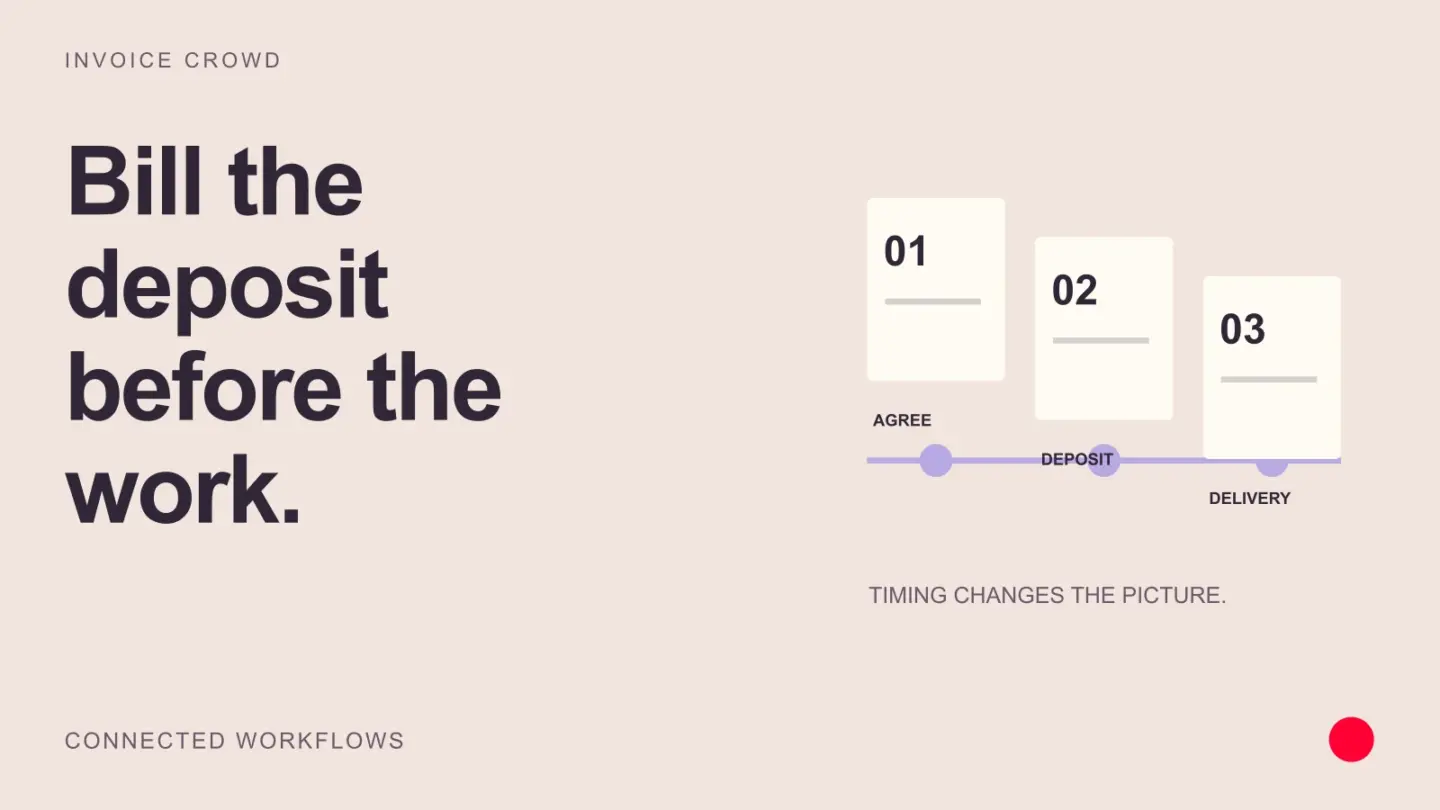
To invoice a deposit before work starts, agree the full price and the deposit in the estimate or contract, send a deposit invoice that references that total, and record the payment as money held for the project. On the final invoice, show the deposit as a deduction so the client pays only the remaining balance.
A deposit does two jobs: it confirms commitment, and it changes how much money is still owed at delivery. Confusion begins when the proposal, deposit invoice, payment and final invoice each show a different version of the price. One schedule should connect all four.
What is a deposit invoice?
A deposit invoice is a request for part of the total project price, paid upfront before you start the work or order goods. It is normal practice in design, events, custom manufacturing and construction, where you commit time and resources, or buy materials, that you cannot resell if the client walks away.
A deposit, a retainer and a partial payment are treated differently in the contract and the books. Our guide to hourly, fixed-fee and retainer billing covers the retainer side.
| Term | Typical commercial purpose | Question to resolve |
|---|---|---|
| Deposit | Commitment before work or delivery | Is it refundable and when does tax apply? |
| Retainer | Reserve access or prepay a service relationship | When is it earned and how is usage shown? |
| Partial payment | Settle part of an issued invoice | Which invoice and balance does it reduce? |
| Milestone payment | Pay when a defined phase is reached | What evidence proves the milestone? |
When to request a deposit upfront, and how much
Ask for a deposit to cover initial costs and to protect your business from the financial risk of a cancelled booking. It helps most on larger projects, new clients, custom goods and dates you turn other work away for. For small repeat jobs with clients who pay on time, it can add friction for little benefit.
- Service work: 25% to 50% is common, with 50% for short projects where the money funds most of the early effort.
- Goods or materials: a contractor or maker should set the deposit to cover these costs at least, so you are never financing a client’s order.
- Construction deposits: check the law before you set the figure. In California, the Contractors State License Board says a home improvement down payment should never exceed 10 percent of the contract price or $1,000, whichever is less.
General contractors and builders often pair a small deposit with progress billing, so cash flow keeps pace with job costing as each stage is finished. See our guide to milestone billing.
Step 1: put the deposit in the agreement
The proposal or estimate should show the total price, the deposit amount or percentage, the due date or acceptance trigger, the refund and cancellation rules and what happens to the remaining balance. A payment request cannot repair terms that were never agreed.
- Full contract or estimated value
- Deposit amount or formula
- Date or event that makes it due
- Whether it is refundable, and when
- Tax treatment, confirmed for your location
- Remaining schedule, such as the balance due on completion
For wording you can paste into a quote, see our payment terms examples.
Step 2: send a deposit invoice the client can reconcile
The invoice should name the customer, the agreement or project, the amount, currency, tax treatment, due date and payment instructions, and show how the amount relates to the full price. Avoid a lone line called “Deposit” with no reference to the work. Any invoice template works if it carries these lines:
| Line on the document | Oakline example | Why it helps |
|---|---|---|
| Project reference | Website redesign, proposal P-104 | Connects money to approved scope |
| Contract value | $10,000.00 | Shows the base for the percentage |
| Deposit due | 30%, $3,000.00, due on signing | Makes the requested amount unambiguous |
| Remaining schedule | $7,000.00 due on completion | Prevents surprise at final billing |
Tax can apply before the work starts. In the UK, HMRC says most deposits serve as advance payments and create a tax point (VAT Notice 700, paragraph 14.2.3), so VAT is due on the date you receive the money or issue the VAT invoice, whichever comes first. In the US, sales tax rules on deposits vary by state, so ask your accountant before you automate the workflow.
Step 3: record the deposit as a liability until the work is done
When Halden Dental pays the $3,000, Oakline has cash but has not earned anything yet. The $3,000 sits on the balance sheet as a liability until the work is delivered. Log a deposit with its bank or provider reference, date, amount, currency and fees, against the customer and project it belongs to. A bank deposit with no customer allocation is hard to apply later.
| Entry | Debit | Credit |
|---|---|---|
| Deposit received: Cash | $3,000 | |
| Deposit received: Customer deposits (liability) | $3,000 | |
| Final invoice: Accounts receivable | $8,200 | |
| Final invoice: Customer deposits | $3,000 | |
| Final invoice: Revenue | $11,200 |
If the payment arrives in another currency, keep the customer amount and the accounting amount, plus the rate and date used. To properly reflect deposits collected against an existing invoice instead, see how to record a partial payment and track the remaining balance.
Step 4: apply that deposit on the final invoice
The final invoice should show the approved work, any approved changes, the deposit already paid and the balance due. The client should not have to subtract an old invoice in their head, and your books should not count the same money twice. When the scope changes, update the contract value through a documented change first. A 30% deposit tied to the original scope does not silently become 30% of every later addition.
| Description | Amount |
|---|---|
| Approved project total | $10,000.00 |
| Approved change: booking integration | $1,200.00 |
| Subtotal before deposit | $11,200.00 |
| Deposit already paid (invoice OAK-0231) | ($3,000.00) |
| Remaining amount due | $8,200.00 |
Cancellations, refunds and non-refundable deposits
Do not delete the deposit record when a project is cancelled. Apply the agreed policy: keep an earned amount, issue a credit, refund money or carry it to another engagement.
- Read the signed refund and cancellation clause.
- Calculate earned, retained, credited and refundable amounts separately.
- Issue the appropriate credit or adjustment document.
- Process and verify any refund through the provider or bank.
- Reconcile the customer balance, cash and accounting entries.
See credit notes, refunds and debit notes for the document each outcome needs.
How to ask for a deposit without sounding awkward
Present it as how you work, not as a test of trust, and put it in the quote before the client says yes. A short note is enough:
Hi Sarah, thanks for approving the redesign. Attached is invoice OAK-0231 for the 30% deposit of $3,000, due by April 27, which reserves our start date of May 4. The remaining $7,000 is due on completion, as set out in proposal P-104.
How Invoice Crowd helps you collect a deposit and get paid
In Invoice Crowd, Request Deposit adds a percentage or flat-amount deposit to an estimate or invoice, and the totals show Deposit Requested and Deposit Due. When the client accepts such an estimate, they can pay the deposit at once or accept and pay later; accepting turns the estimate into an invoice and takes them to the payment. The client’s page then shows a Payment Schedule, with the deposit due now and the balance to follow.
Money that arrives before any invoice exists can be recorded as an advance payment, held as a customer advance with its own receipt, and applied to the invoice when you bill. See estimates and online payments, and our proposal to invoice workflow.
Frequently asked questions
Is it normal to pay a deposit before work is done?
Yes. Deposits are standard for custom work, events, construction and creative projects, where the business commits time or buys materials before delivery. Written into the quote with its refund rules, a deposit protects both sides: the client secures the date and the business is not financing the project.
Do I need an invoice for a deposit?
Usually, yes. Many clients cannot pay without an invoice, and in some countries the payment triggers tax that a proper invoice must show. The deposit invoice should name the project, the full price, the deposit amount and the remaining schedule.
How do I invoice a 50% deposit?
Show the full contract value, then a line for the 50% deposit due now. On a $6,000 project, the deposit invoice asks for $3,000 and states that $3,000 is due on completion. The final invoice shows $6,000, less the $3,000 deposit paid, with $3,000 due.
Can I keep a deposit if a customer cancels?
Only as your signed terms and local law allow. A non-refundable deposit is easier to keep when it matches costs you already incurred, such as materials or a booked date you cannot resell. Record what you keep, credit or refund, and never delete the original record.