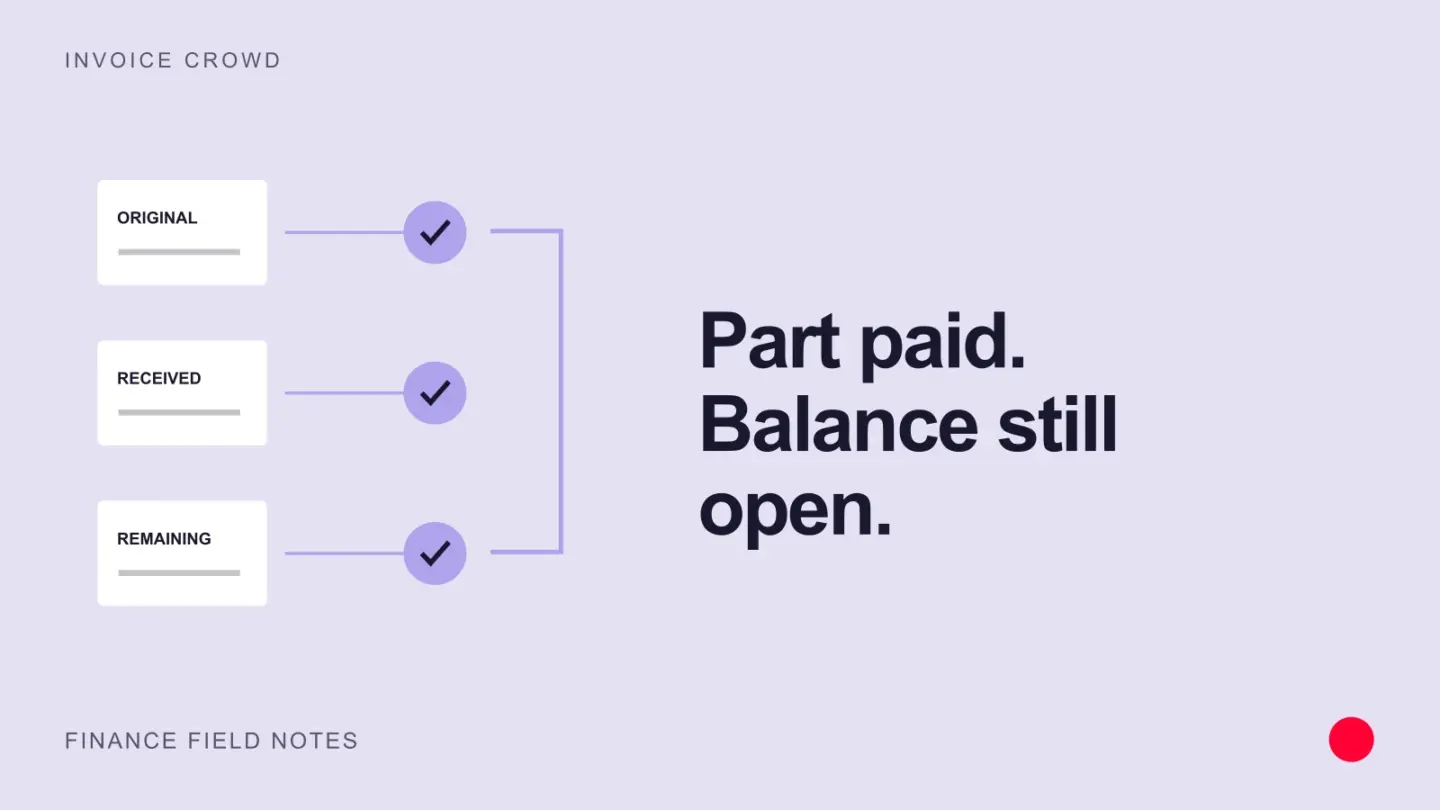
A partial invoice payment settles only part of the amount due and leaves a supported remaining balance on the original invoice.
Record the receipt against the invoice, preserve tax and currency details, show the residual amount and distinguish a partial payment from a deposit or credit note.
Partial payment invoice accounting example
A $6,000 invoice receives a $2,000 payment. Record the full invoice under the applicable revenue and tax rules, then apply the $2,000 customer payment to leave a $4,000 remaining balance. The payment is not new revenue merely because it arrives on a different date.
| Event | Receivable effect | Evidence |
|---|---|---|
| Invoice issued | $6,000 open | Invoice and source agreement |
| Partial payment | Reduce by $2,000 | Bank or processor reference and allocation |
| Remaining balance | $4,000 open | Updated customer account and due date |
Do not create a replacement invoice for every installment unless the contract and accounting treatment call for separate billing. Distinguish a deposit, upfront payment, installment, and ordinary short payment.
Keep the full invoice and the payment history
After a $2,000 payment on a $6,000 invoice, the original charge remains $6,000 and the open balance is $4,000. Do not replace the invoice with a new $4,000 charge unless the correction rules require a separate document. Show the payment date and reference, and make subsequent reminders refer to the remaining balance.
Example
A customer pays $600 against a $1,000 invoice, leaving $400 outstanding with the original due date unless a new agreement changes it.
What to watch for
Marking the invoice paid or creating an unexplained second invoice for the balance breaks the audit trail and collection history.
Put the next step into practice
Read our guide to payment links and invoices for the related workflow. Explore Invoice Crowd partial payments to see the product capabilities relevant to your setup.