Marisol Ortiz, a bookkeeping consultant, invoiced Pine & Pike Outfitters $1,200 on August 1 with Net 15 terms. The client paid $400 by bank transfer on August 10, and its controller asked for “a receipt.” Marisol sent the invoice again. It still said $1,200 due, so it proved nothing about the $400.
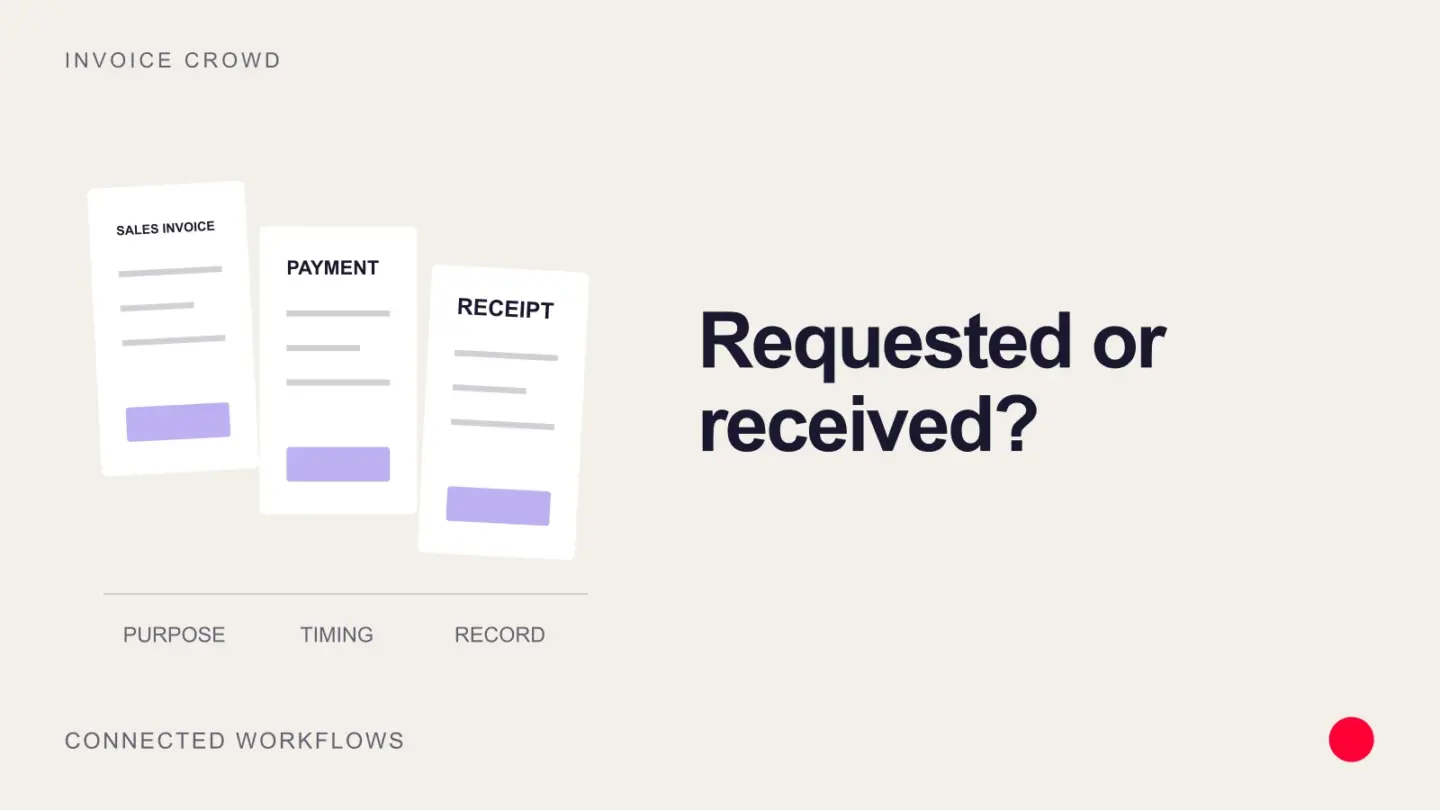
A sales invoice requests or records the amount a customer owes for a sale, while a receipt confirms that payment has been received. The invoice comes first, at the billing stage, with the amount due and payment terms. The receipt comes after the money arrives, as proof of payment for the amount paid.
Sales invoice vs receipt: the key differences
Invoices and receipts serve different purposes at different stages of the sales process, and each document carries different information.
| Question | Sales invoice | Receipt |
|---|---|---|
| Purpose | A formal request for payment | Confirms the customer has paid |
| Who creates it? | The seller | The seller or its payment system |
| When? | Before payment, at the billing event or under credit terms | At or after payment |
| What amount? | Total amount, tax, prior payments and amount due | Amount paid, payment method and any balance left |
| Key reference | Invoice number and due date | Receipt number linked to the invoice |
| In the books | Creates accounts receivable | Clears accounts receivable |
| Main evidence | Goods or services billed and payment terms | Proof of payment |
A useful shorthand: the invoice says “you owe this,” and the receipt says “you paid this.” One never replaces the other on a credit sale.
What is a sales invoice?
A sales invoice is a document issued by the seller to request payment from a customer for goods or services already delivered or agreed. It turns the sale into an amount owed. Under accrual accounting, issuing it records revenue and a matching balance in accounts receivable until the customer pays.
A standard invoice should include your business details, the customer’s name and address, a unique invoice number, the invoice date and due date, a description of each item with quantity and pricing, any tax, the total amount and your payment terms and instructions. Our guide to what an invoice is covers each field in detail.
Marisol’s invoice INV-0412 showed $1,200 for 12 hours of monthly bookkeeping at $100 an hour, Net 15, due August 16. That is everything the client needed to approve and pay it, and nothing that proves payment.
What is a receipt?
A receipt is a document issued after payment that confirms money changed hands. It should show the amount paid, the payment date, the payment method, what the payment was for and, for a partial payment, the balance still owed. A receipt helps both sides: the customer has proof of payment, and the seller has a record that ties the money to a specific invoice.
A sales receipt is a slightly different thing. It records a sale and its payment in one moment, like the slip a shop hands you at the register. There is no invoice because there is no credit period. A payment receipt, by contrast, confirms payment against an invoice issued earlier.
When to use an invoice, a receipt or both
Use the timing of payment to decide which document you need to issue.
- Customer pays later: send an invoice to request payment, then issue a receipt once payment is received. This is the normal pattern for services and B2B work.
- Customer pays on the spot: a sales receipt is enough, unless the customer asks for an invoice for their own records or a tax rule requires one.
- Customer pays in parts: issue one invoice and a receipt for each payment, each showing the remaining balance.
- Customer pays a deposit before you invoice: issue a receipt for the advance, then apply it to the invoice when you bill. See our guide to invoicing a deposit.
So, do you need to issue both an invoice and a receipt? On any sale where payment is due later, yes. Many businesses issue both even when the law does not require it, because the pair answers most questions a customer’s accountant will ask.
Can an invoice be used as a receipt?
Only once it is paid, and only if it says so clearly. A paid invoice can serve as proof when it records the payment date, amount, method and a zero balance. An unpaid invoice is never proof of payment: it only shows the amount owed.
Partial payments are where this breaks down. Pine & Pike paid $400 of $1,200, so the invoice balance is $800. Marking the whole invoice paid would hide the $800 still owed, and re-sending the unchanged invoice proves nothing. The fix is a receipt for $400 that names INV-0412, the August 10 date, the bank transfer and the $800 balance. When the client paid the remaining $800 by credit card on August 16, a second receipt closed the invoice. Our guide to partial payment accounting shows the entries.
In Invoice Crowd, every payment you record on an invoice gets its own payment receipt PDF, numbered RCT-P for a part payment and RCT-F for a full payment. Tick “Email Payment Confirmation to Client” when you record it, and the confirmation email goes out with the receipt attached. See how payments received are tracked.
How to write an invoice and how to write a receipt
Write an invoice
- Add your business details and the customer’s billing details.
- Give it a unique, sequential invoice number and the invoice date.
- List each item or service with quantity, rate and amount.
- Add tax where it applies, then the total amount.
- State the payment terms, the due date and how to pay.
Write a receipt
- Title it “Receipt” and give it its own number.
- Name the customer and the invoice the payment settles.
- Record the amount paid, payment date and payment method.
- Show the balance remaining, even when it is zero.
An invoice template works for a small business with a few sales a month. Past that, invoicing or accounting software that creates the receipt from the recorded payment avoids retyping numbers, which is where most receipt errors start.
Invoices and receipts for tax and record keeping
For tax purposes, the two documents prove different things, and tax authorities often accept several kinds of evidence. The IRS lists invoices, cash register tapes, receipt books and deposit records among the supporting documents for gross receipts. For purchases and expenses, it lists invoices alongside canceled checks, credit card receipts and statements. A sales invoice can therefore support a purchase, but proof that you paid it usually comes from the bank record or receipt.
Some countries are specific about which document counts. In the Philippines, the Bureau of Internal Revenue’s Revenue Memorandum Circular No. 77-2024 states that the invoice is now the primary evidence for recording sales of goods and services, and that the official receipt is treated as a supplementary document. If you sell in a country with rules like these, check the tax authority’s own guidance before deciding which document to issue. Our guide to tax invoices explains where the stricter formats apply.
Whatever the rules, keep each invoice, its receipts and the matching bank or card record connected. One document rarely proves every fact on its own. Read our guide to purchase orders, invoices and bills for how these documents fit with the buyer’s side.
Frequently asked questions
Does issuing an invoice mean I’ve been paid?
No. Issuing an invoice means the customer owes you the amount on it. You have been paid only when the money reaches your account. Until then, the invoice sits in accounts receivable. Record each payment as it arrives and issue a receipt, so your records show exactly what is paid and what is still due.
Do I need a receipt if I have an invoice?
If you are the buyer, the invoice shows what you were charged, and your bank or card statement shows that you paid. Many accountants still want a receipt or a paid invoice because it ties the two together. If you are the seller, send a receipt whenever a customer pays against an invoice. It costs nothing and heads off disputes about what was paid.
Can I create an invoice after the customer pays?
Yes. A customer may pay first and still need an invoice for their records or tax claims. Issue the invoice with the real invoice date, record the payment against it and show a zero balance. Never backdate it to look as if it was sent before the payment.
Is a sales receipt the same as an invoice?
No. A sales receipt records a sale that was paid at the moment it happened, so no amount is owed. An invoice records a sale the customer will pay for later, under the payment terms. If the customer pays on the spot, a sales receipt usually does the job, unless they ask for an invoice.
To bill clearly and keep every payment tied to the right invoice, explore Invoice Crowd invoicing.