Harbourline Studio, a six-person design firm in Sydney, bills a group of medical clinics A$5,500 for a new brand identity: A$5,000 for the work plus A$500 of GST. Two days later the clinics’ accounts team sends the invoice back. It shows the studio’s ABN and the tax, but not the buyer’s name or ABN, and without those the clinics cannot claim the A$500 back.
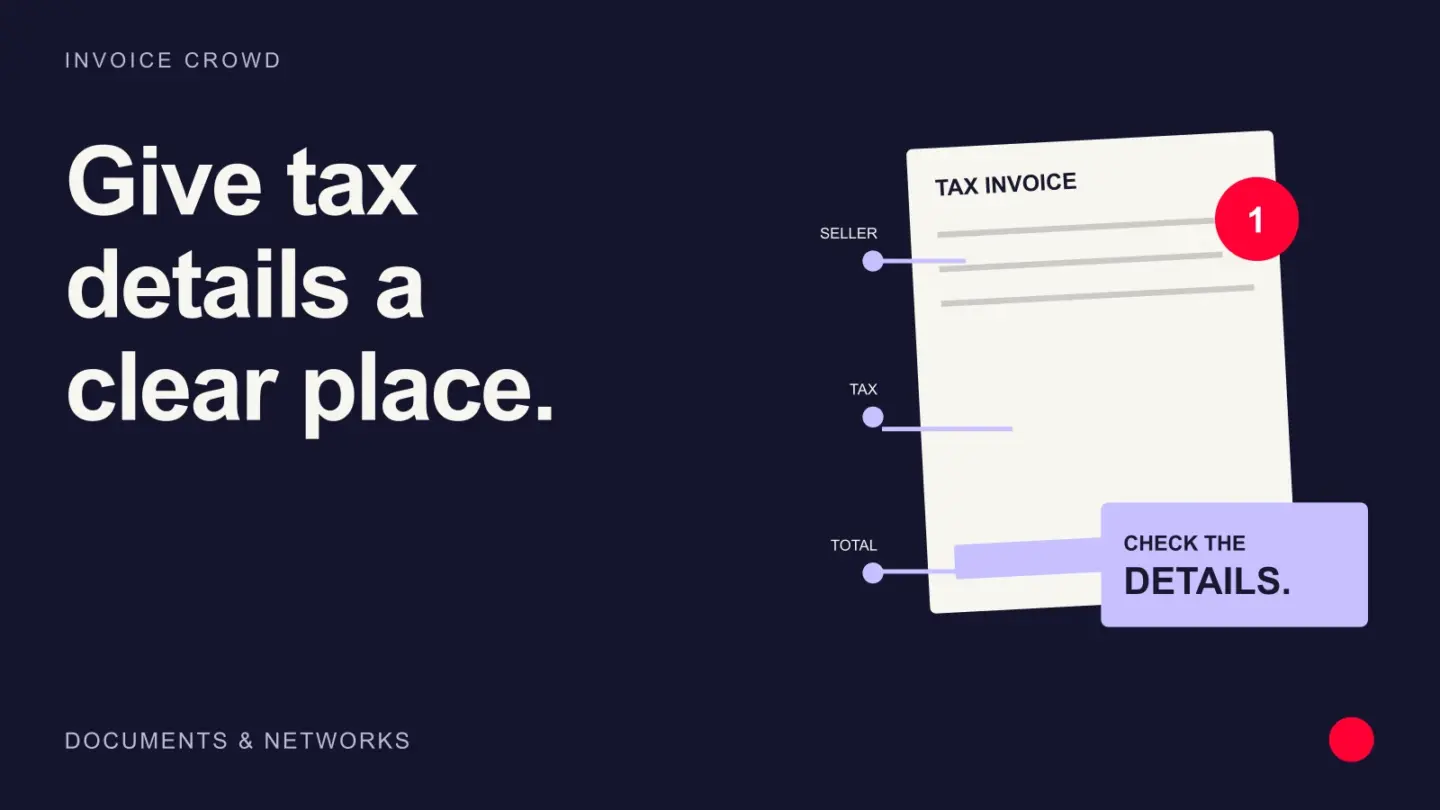
A tax invoice is an invoice that carries the details a tax system requires to document a taxable sale: who sold it, to whom, what was supplied, when, and how much GST or VAT was charged. Its main job is to let a registered buyer claim an input tax credit for the tax it paid.
What is a tax invoice used for?
A tax invoice is a document issued by a business registered for a value-added tax, such as VAT in the UK and the EU, or goods and services tax (GST) in Australia, Singapore and India. Tax invoices are used by three parties. The buyer keeps them to claim tax credits on purchases, which is why accounts payable teams check them before paying. The seller uses its copies for tax reporting. National or regional tax authorities compare both sides in an audit, matching the tax one business charged with the credit another claimed to spot fraud.
HMRC calls the VAT invoices a business receives “the primary evidence” for recovering VAT as input tax (VAT Notice 700/21). In Australia, you need a tax invoice to claim the credit on any purchase over A$82.50 including GST (ATO: BAS and GST tips). So tax invoices are important even after the customer has paid.
The United States has no national VAT or GST. Sales tax is charged by states and local governments on retail sales, so a US invoice shows the sales tax but there is no input tax credit for it to support.
Invoice vs tax invoice: the difference between a tax invoice and a regular invoice
A regular invoice asks for payment. A tax invoice also proves a taxable supply, so it must show the seller’s registration number, the tax rate and the amount of tax in the form local tax laws set. Only a registered business can issue one: the ATO says an unregistered business must issue standard invoices, without the words “tax invoice” and without GST in the price (ATO: setting up your business invoices).
| Document | What it proves | Supports an input tax credit? |
|---|---|---|
| Regular invoice | That a seller billed goods or services | Only if it also meets the local tax requirements |
| Tax invoice | A taxable supply and the tax charged on it | Yes, when the buyer and purchase qualify |
| Receipt | That payment was made | Only for small purchases, where allowed |
| Bill of supply (India) | A supply with no GST charged | No, because no tax is shown |
India’s bill of supply comes from section 31(3)(c) of the CGST Act: a registered person supplying exempt goods or services, or paying tax under the composition scheme, issues one instead of a tax invoice (CBIC). Australia also allows a recipient-created tax invoice (RCTI), issued by the buyer instead of the seller, when the ATO’s conditions are met.
Is there a difference between a tax invoice and a receipt?
Yes. One records the sale and the tax; the other records the payment. In Australia, a receipt or cash register docket is enough for purchases of A$82.50 or less (ATO). In Singapore, a registered seller may give a receipt to a customer who is not GST-registered. Our guide to sales invoices and receipts covers the rest.
What is included in tax invoices: tax ID, GST and VAT rules by country
There is no universal template. In each of the systems below, a full tax invoice must include the seller’s tax identification number, the date, a description of what was sold and the tax charged. The table shows where three tax authorities draw the lines.
Tax invoice requirements in Australia, the UK and Singapore
| Rule | Australia (ATO) | UK (HMRC) | Singapore (IRAS) |
|---|---|---|---|
| Tax ID shown | Seller’s ABN | Supplier’s VAT number | Supplier’s GST registration number |
| Buyer details | Identity or ABN for sales of A$1,000 or more | Name and address on a full invoice | Name and address on a full tax invoice |
| Shorter version allowed | No buyer details under A$1,000 | £250 or less including VAT | S$1,000 or less including GST |
| Deadline to issue | 28 days after the buyer asks | Normally 30 days after the supply | 30 days after the time of supply |
| Keep records for | 5 years | At least 6 years | At least 5 years |
Sources: ATO: tax invoices; HMRC VAT Notice 700/21, sections 2.4, 3.1 and 4; IRAS: invoicing customers and keeping records. IRAS also wants the words “Tax Invoice” shown prominently. For UK sales, check GOV.UK’s invoices and VAT invoices: what they must include.
Tax invoice example: the corrected Harbourline invoice
Harbourline’s sale is over A$1,000, so the buyer’s details are required. The studio cancels the rejected version with a credit note, so its own records count the sale once, and issues tax invoice HS-0418, dated 3 November 2026, with the clinic group’s legal name and ABN below its own.
| Description | Qty | Price excl. GST | GST | Amount |
|---|---|---|---|---|
| Brand strategy workshop | 1 | A$1,200 | A$120 | A$1,320 |
| Logo and identity system | 1 | A$2,800 | A$280 | A$3,080 |
| Brand guidelines | 1 | A$1,000 | A$100 | A$1,100 |
| Total | A$5,000 | A$500 | A$5,500 |
Each line is taxable at the 10% GST rate, and the tax is shown as a separate amount. The clinics can now claim the A$500 as a GST credit on their next activity statement.
When is a tax invoice required?
Whether tax invoices are mandatory depends on who is buying and where. The usual trigger is a taxable sale between two registered businesses. GOV.UK puts it plainly: you must use VAT invoices if you and your customer are both VAT registered. Singapore requires them only for GST-registered customers, and in Australia the seller owes one when the buyer asks, unless the sale is A$82.50 or less.
Small sales can use a simplified invoice with fewer fields. One trap: in the UK, exempt supplies must not appear on that type of invoice, so a mixed sale needs a full one.
Digital and e-tax invoices: are they valid?
Generally, yes. The European Commission states that electronic invoices are equivalent to paper ones and may be issued subject to the recipient’s acceptance (EU VAT invoicing). IRAS asks that electronic tax invoices be kept in a human-readable format. Some countries now require structured e-invoices in XML for certain sales, which a PDF does not satisfy; see whether a PDF counts as an electronic invoice.
Common tax invoice mistakes
- Missing buyer details above the threshold. Harbourline’s error is the classic cause of invoice rejections or disputes, and it puts the buyer’s credit at risk.
- Gaps in numbering. HMRC’s first requirement for a full VAT invoice is a sequential number. See our invoice numbering formats.
- Editing a sent invoice. Correct it with a credit note that references the original, then issue a new tax invoice. Our guide to credit notes, refunds and debit notes shows which fits.
- Treating a pro forma invoice as a tax invoice. It previews a sale and cannot support a tax claim.
How to create a tax invoice
- Confirm your registration number and whether the sale needs a full or simplified invoice.
- Use the next number in your sequence and the date of issue.
- Add the buyer’s legal name, plus address or tax ID where required.
- Apply the applicable tax rate to each line and show the tax paid.
- Send it within the local deadline and keep a copy for the full period.
Software turns most of this into one-time setup. In Invoice Crowd, the invoice title is editable, so it can read Tax Invoice, and tax is set for each line, with suggested rates for countries including Australia, the UK and Singapore. Your tax registration number lives in your business profile and the customer’s in their record. An ABN or UK VAT number with a failed check digit is rejected, and the number is frozen on each invoice once it is finalized.
Frequently asked questions
Is a tax invoice the same as a receipt?
No. A tax invoice records a taxable sale and the tax charged on it, usually before payment. A receipt confirms that payment was made. Some systems accept a receipt for small purchases, such as A$82.50 or less in Australia, but above that a buyer needs a valid tax invoice to claim the credit.
Can I issue a tax invoice without a GST or VAT number?
No. Only a business registered for GST or VAT can charge the tax and issue tax invoices. The ATO says an unregistered business must issue standard invoices that leave out the words “tax invoice” and include no GST. If your sales pass the registration threshold, register before you start charging tax, and ask a tax advisor if you are unsure.
How long should you keep tax invoices?
Keep the tax invoices you issue and receive for as long as your local tax authority requires: 5 years in Australia and Singapore, and at least 6 years for UK VAT records. Electronic copies are fine if you can retrieve and read them. Keep credit notes alongside the invoices they correct.
Are digital tax invoices accepted by tax authorities?
Generally, yes. EU rules treat electronic invoices as equivalent to paper ones when the recipient accepts them, and Singapore accepts electronic tax invoices kept in readable form. Some countries go further and require structured e-invoices for certain sales, so check your local tax regulations before relying on a PDF alone.
Read our guide to purchase orders, invoices and bills for the related workflow. Explore Invoice Crowd invoicing to see how it fits the way you bill.