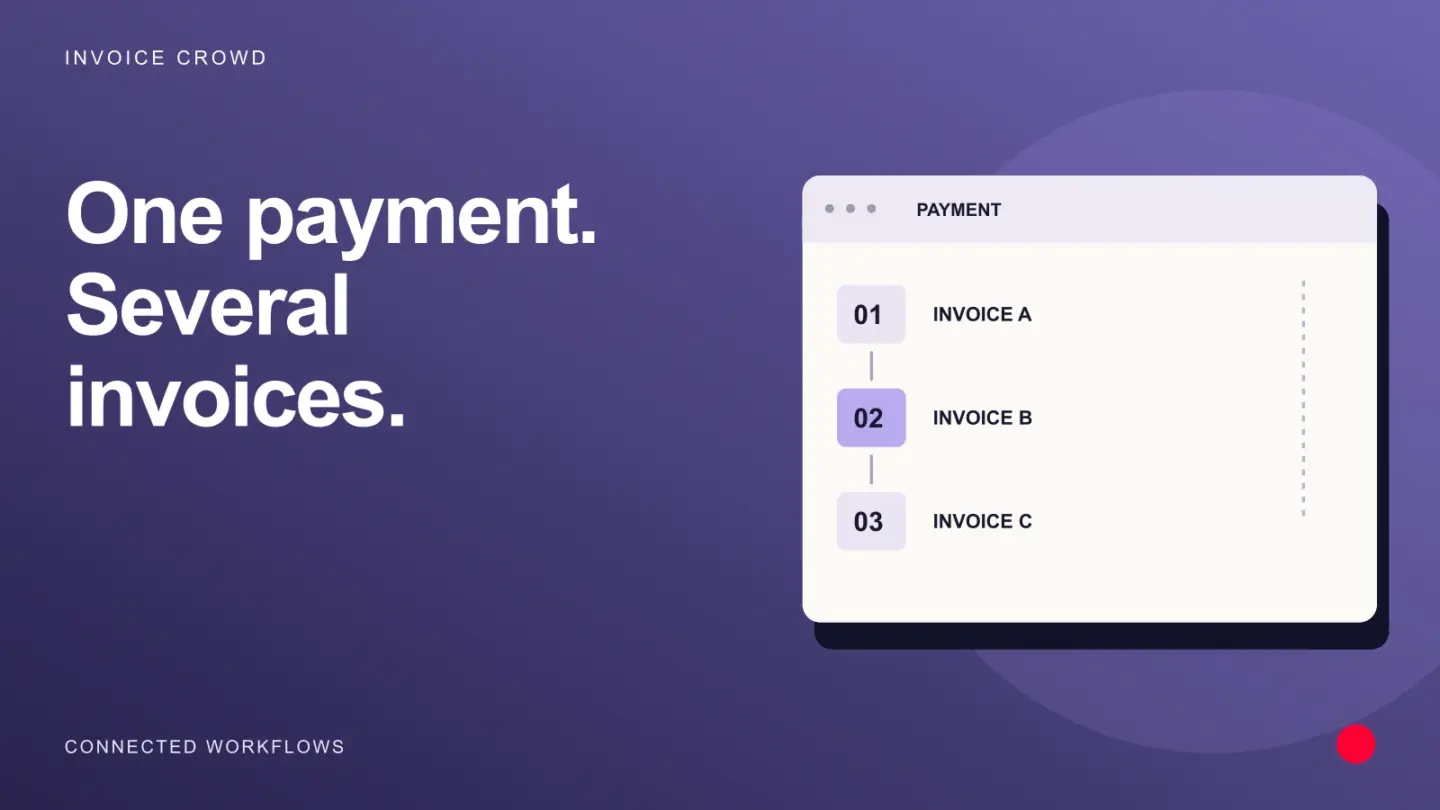
Payment allocation is the process of assigning a customer payment to the invoices or balances it pays. To allocate one payment across several invoices, confirm the customer and currency, check the remittance instructions, enter the amount against each invoice, and leave any unpaid balance visible.
A receipt in your bank account tells you money arrived. It does not always tell you which invoices the customer intended to settle. A clear allocation record connects the two and helps prevent incorrect overdue notices, duplicate entries and unexplained customer credits.
How payment allocation works
In accounts receivable, allocation answers a practical question: which invoice balances should this payment reduce? It can close several invoices in full, partly settle one invoice, or leave an amount unapplied while you clarify the customer’s instructions.
These related tasks serve different purposes:
- Payment allocation: assigns the receipt to specific invoices.
- Partial payment: pays only part of an invoice, leaving a remaining balance.
- Payment reconciliation: checks that payment records agree with processor and bank activity.
Allocating a receipt does not, by itself, confirm that the funds have settled in your bank. Keep the allocation record and the settlement check connected.
How to allocate one payment across multiple invoices
- Identify the receipt. Record the customer, payment date, payment amount, currency and transaction reference. Check that the payment has not already been recorded.
- Find the remittance advice. Look for an invoice number in the bank reference, a payment email or an attached statement. Check the instruction against the customer’s account and agreed terms.
- Compare the open balances. Review previous payments and credit notes before deciding what remains due. Do not allocate against an invoice that is already paid in full.
- Enter the allocation. Assign the agreed amount to each invoice. The amounts allocated, plus any amount left unapplied, should equal the receipt.
- Review exceptions. Investigate short payments, overpayments and disputed deductions rather than changing an invoice total just to make the figures match.
- Confirm the result. Save the remittance evidence and send a receipt or updated statement showing which invoices were paid and what remains outstanding.
Worked example: a $1,500 payment for three invoices
Suppose a customer has three open invoices and sends $1,500 with instructions to pay invoice A in full and put the rest toward invoice B.
| Invoice | Open balance | Payment allocated | Balance remaining |
|---|---|---|---|
| A | $1,000 | $1,000 | $0 |
| B | $800 | $500 | $300 |
| C | $400 | $0 | $400 |
| Total | $2,200 | $1,500 | $700 |
Invoice A is paid in full. Invoice B is partially paid, and invoice C remains open. Record one receipt with allocations totaling $1,500, rather than three separate $1,500 receipts. Keep the $300 and $400 balances on the customer statement.
Under a simple accrual-accounting example, where the invoices were already recorded and there are no fees, tax adjustments or exchange differences, the receipt increases cash by $1,500 and reduces accounts receivable by $1,500. The invoice-level allocation explains which receivables were reduced; it does not create a second sale.
Which payment allocation method should you use?
Start with the customer’s valid instructions, the contract and any applicable requirements. If those do not resolve the allocation, ask the customer or apply a documented, agreed policy. Do not assume that the oldest invoice must always be paid first.
| Situation | Practical next step |
|---|---|
| Invoice numbers and amounts are supplied | Check the details and allocate to those invoices. |
| No invoice reference is supplied | Ask for remittance details. Keep the receipt identifiable while you resolve it. |
| The payment is less than the invoice balance | Apply the confirmed amount and retain the unpaid balance. Ask whether the difference is an agreed discount, dispute or error. |
| The payment exceeds the intended invoices | Record the excess as an unapplied receipt or customer credit, as appropriate, and confirm whether to apply it elsewhere or refund it. |
| A deduction is disputed | Keep the disputed amount traceable and resolve it before approving a credit or write-off. |
| A payment was allocated incorrectly | Use your system’s correction process and retain the reason, approval and revised allocation. |
Common mistakes to avoid
- Using the net bank deposit as the customer payment. A processor may deduct a fee before payout. Record the customer receipt and fee separately rather than leaving the customer falsely short-paid.
- Applying money across the wrong accounts. Similar business names do not prove two customer records or legal entities are interchangeable.
- Mixing currencies without a conversion record. Keep the payment currency, invoice currency and applicable exchange-rate treatment clear.
- Hiding a difference. An unexplained discount, credit or write-off is not a substitute for investigating a mismatch.
- Changing closed-period records casually. Ask your accountant how to correct an allocation that affects a finalized reporting period.
Is this the same as credit-card payment allocation?
No. This guide concerns payments received against business invoices. Credit-card payment allocation describes how a card issuer applies a cardholder’s payment among balances with different interest rates.
For covered US consumer credit-card accounts, Regulation Z, section 1026.53 generally directs amounts above the required minimum payment to the highest-APR balance first, with special rules including deferred-interest balances. That rule is not a general allocation policy for customer invoices.
Payment allocation FAQs
Can one payment pay several invoices?
Yes. Allocate a portion of the receipt to each intended invoice and check that the total applied does not exceed the payment received. Keep one transaction reference connecting the allocations.
What is an unapplied payment?
It is a receipt that has been recorded but has not yet been assigned to an invoice. Investigate the customer and remittance details, then apply it or handle it as a credit or refund as appropriate.
Should I always pay the oldest invoice first?
No. Oldest-first can be a documented default where appropriate, but it should not override valid customer instructions, contract terms or applicable rules. Clarify ambiguous or disputed payments before allocating them.
Does splitting an invoice mean allocating a receipt across invoices?
No. Splitting an invoice divides one invoice into payment installments. Allocating a receipt across invoices connects one incoming payment to several existing invoice balances.
Keep the payment record clear for your customer
Ask customers to include invoice numbers when paying and show each allocation on their statement. For a single invoice paid over time, Invoice Crowd’s split and partial payment options support agreed installments or partial amounts above a minimum you set. Check the workflow you need rather than assuming installment features also allocate one receipt across multiple invoices.
If you are choosing how to request the payment, see our guide to payment links and invoices.