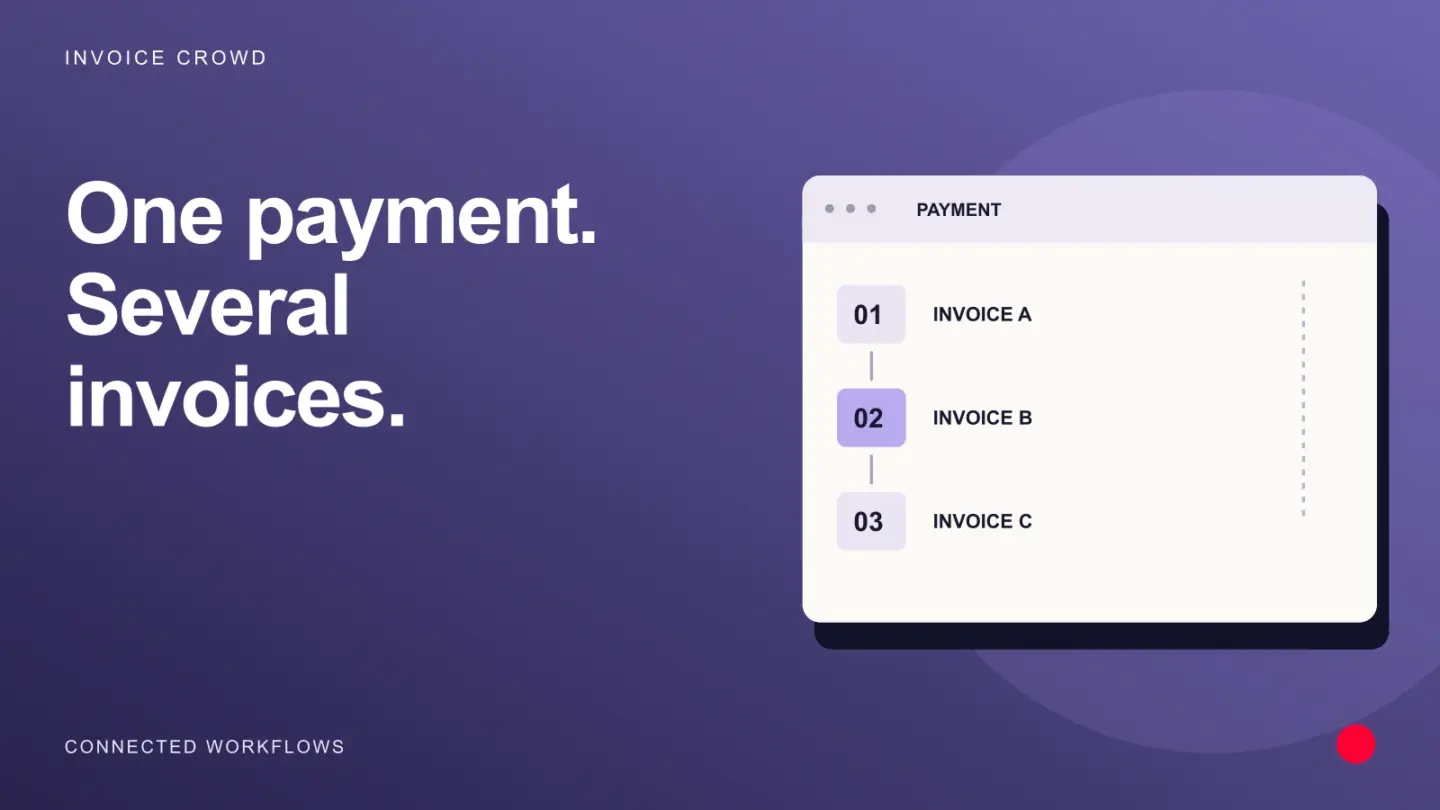
Pinecrest Dental owes Harbor Lane Studio $2,200 across three invoices. On March 14 a $1,500 bank transfer arrives with a one-line note: “Pay 1041 in full, rest to 1047.” Record it carelessly and one invoice looks paid twice while another earns an undeserved overdue reminder.
Payment allocation is the process of assigning a customer payment to the invoices or balances it pays. To allocate one payment across several invoices, confirm the customer and currency, read the remittance instructions, enter an amount against each invoice, and leave any unpaid balance visible until it is settled.
How payment allocation works
A bank receipt proves money arrived. It does not say which debts the customer meant to settle. Allocation answers that question at invoice level: which balances does this payment reduce, and by how much? One payment can close several invoices, partly pay one, or wait as unapplied cash while you confirm the instructions.
Four related tasks often get blurred:
- Allocation: assigns one receipt to specific invoices.
- Partial payment: pays part of one invoice and leaves a balance (see partial payment accounting).
- Cash application: the daily routine of matching receipts to customers and invoices (see the cash application process).
- Payment reconciliation: proves your payment records agree with processor and bank activity.
Allocation and settlement are separate facts. A card payment can be allocated to an invoice today and reach your bank two days later, so keep the allocation tied to the deposit that eventually carries it.
How to allocate one payment across multiple invoices
- Identify the receipt. Record the customer, payment date, payment amount, currency and transaction reference. Confirm the payment has not already been entered.
- Find the remittance advice. Look for invoice numbers in the bank reference, a payment email or an attached statement, and check them against the customer’s account.
- Compare the open balances. Review earlier payments and credit notes before deciding what is still due. Never allocate against an invoice that is already paid in full.
- Enter the allocation. Assign the agreed amount to each invoice. The amounts allocated, plus anything left unapplied, must equal the receipt.
- Review exceptions. Investigate short payments, overpayments and deductions. Do not edit an invoice total to make the figures match.
- Confirm the result. Save the remittance evidence and send a receipt or updated statement showing what was paid and what remains.
Worked example: a $1,500 payment against three open balances
Pinecrest’s instruction is clear, so Harbor Lane follows it.
| Invoice | Open balance | Payment allocated | Balance remaining |
|---|---|---|---|
| INV-1041 | $1,000 | $1,000 | $0 |
| INV-1047 | $800 | $500 | $300 |
| INV-1052 | $400 | $0 | $400 |
| Total | $2,200 | $1,500 | $700 |
INV-1041 is paid in full, INV-1047 is partly paid, and INV-1052 is untouched. Harbor Lane records one receipt with two allocations totaling $1,500, not separate receipts for each invoice. The $300 and $400 balances stay on the client’s statement.
With no fees or exchange differences, the entry is a $1,500 debit to cash and a $1,500 credit to accounts receivable. The allocation explains which receivables went down. It does not create a second sale.
Which payment allocation method should you use?
Valid customer instructions come first, then the contract. When neither settles it, apply a written default and tell the customer. Oldest invoice first is the usual default; spreading the payment in proportion to each open balance is the other. Neither should override a clear instruction, especially when the customer is withholding one invoice over a dispute.
| Situation | What to do |
|---|---|
| Invoice numbers and amounts are supplied | Check them and allocate exactly as instructed. |
| No invoice reference is supplied | Ask for remittance details and keep the receipt identifiable meanwhile. |
| The payment is less than the invoice balance | Apply what was paid and keep the rest open. Ask whether the gap is a discount, a dispute or an error. |
| The payment exceeds the intended invoices | Hold the excess as customer credit, then agree whether to apply it elsewhere or refund it. |
| A deduction is disputed | Keep the disputed amount traceable until a credit note or write-off is approved. |
| A payment was allocated incorrectly | Reverse and reallocate through your system’s correction process, recording the reason and approval. |
What a payment allocation report should show
Give each invoice a receipt pays its own row: customer, receipt reference, invoice number, currency, amount allocated and balance remaining. Show unapplied money on a separate row. The rows for one receipt should total the amount received, so a reviewer can check it without opening the bank feed.
Now suppose Pinecrest writes back in April: $200 of the amount applied to INV-1047 was meant for INV-1052. Move the $200 between the two invoices while keeping the original payment reference. INV-1047’s balance rises from $300 to $500 and INV-1052’s falls from $400 to $200. The combined balance stays $700 and the bank receipt stays $1,500. Send an updated statement of account so collections chases the right invoice. If remittance notes keep arriving vague, give customers a bank transfer reference they can copy.
Common mistakes to avoid
- Treating the net deposit as the customer payment. A processor may deduct its fee before payout. Record the gross receipt and the fee separately, or the customer looks short-paid when they are not.
- Applying money across the wrong accounts. Similar business names do not prove two customer records or legal entities are interchangeable.
- Mixing currencies without a conversion record. Keep the payment currency, invoice currency and exchange rate visible on the allocation.
- Hiding a difference. An unexplained discount or write-off is a way to stop looking, not an answer.
How a payment is applied to each credit card balance
Most search results for this term describe a different problem: how a card issuer splits one monthly payment among balances with different interest rates. A single card can carry a purchase balance, a cash advance balance and a balance transfer, each with its own annual percentage rate (APR). Interest accrues on each separately, so where the payment goes decides how much interest you pay.
Minimum payment versus the excess
For consumer credit card accounts in the US, the Credit CARD Act of 2009 set the order. The rule now sits in Regulation Z, section 1026.53, and it governs the excess payment, meaning anything above the minimum payment. Card issuers must allocate that excess to the balance with the highest interest rate first, then to the remaining balances in descending order. The minimum payment is left to the issuer, and many put it toward the lowest-rate balance.
Take a card with $2,000 of purchases at 19%, a $300 cash advance at 25% and a $1,500 balance transfer at a 0% promotional rate. The cardholder pays $500 against a $60 minimum. The $440 excess clears the $300 cash advance first, and the remaining $140 goes to purchases. The $60 minimum may go to the 0% transfer, which is why making the minimum payment alone leaves the costly balances to accrue interest.
Deferred interest balances
Store credit cards often offer deferred interest: no interest if the balance is paid in full before the promotional period ends, and all the interest that accrued since the purchase if it is not. In the last two billing cycles before that period expires, excess payments must go to the deferred interest balance first. At other times the card issuer may, at its option, allocate them in the manner requested by the consumer.
None of this governs a business invoice. If a client pays you by card, those rules apply to the client’s credit card account. You allocate the receipt by the invoice and the client’s instructions.
Frequently asked questions
What does it mean when a payment is not allocated?
The money has been recorded but not yet assigned to any invoice. It sits as unapplied cash or a customer credit, so the customer’s invoices still look unpaid. Find the remittance details, confirm which invoices the customer meant, then apply it. If nothing is due, agree in writing whether to hold it as credit or refund it.
What does payment allocation mean on a direct deposit form?
On a direct deposit form, allocation tells your employer how to split each paycheck between bank accounts. You choose a fixed amount or a percentage for each secondary account, and the remainder goes to your primary account. Nothing is being settled there; the word simply describes how one sum is divided.
How long does it take for my credit card payment to post?
Under Regulation Z, section 1026.10, a card issuer must credit a payment as of the date it receives it, even if the funds take longer to clear. The issuer can set a cut-off time, but on the due date it cannot be earlier than 5 p.m. at the place where it accepts payments.
Keep the payment record clear for your customer
Ask customers to quote invoice numbers when they pay, and show each allocation on their statement. In Invoice Crowd, the Payments Received screen can apply one receipt across several open invoices, with a Fill Oldest First option, and keeps anything left over as customer credit. For a single invoice paid over time, Invoice Crowd’s split and partial payment options support agreed installments or partial amounts above a minimum you set.
If you are choosing how to request the payment, see our guide to payment links and invoices.