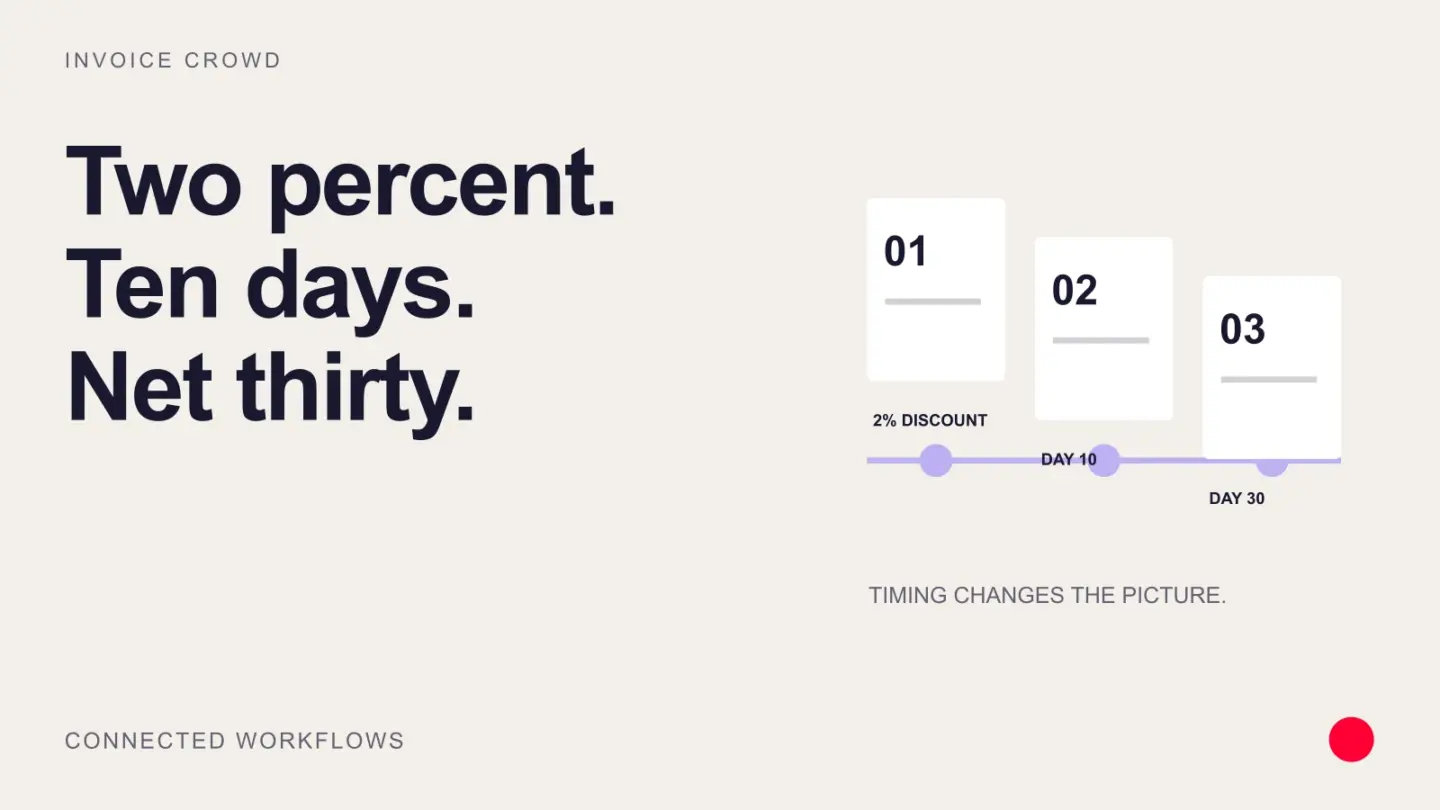
2/10 Net 30 means the buyer can take a 2% early payment discount if it meets a 10-day payment deadline. Otherwise, the full invoice amount is due in 30 days. On a fully eligible $10,000 invoice, that means paying $9,800 within the discount window or $10,000 by the normal due date.
For a buyer, the discount may offer a worthwhile saving if cash is available. For a seller, it is a cost paid to collect sooner. Whether it is worth it depends on cash flow, financing costs, profit margin and how much earlier the customer actually pays.
What does 2/10 Net 30 mean?
| Term | Meaning | On a $10,000 eligible invoice |
|---|---|---|
| 2 | Discount percentage | 2% saves $200 |
| 10 | Discount period | Qualifying payment must meet the agreed 10-day deadline |
| Net 30 | Normal payment period | The full $10,000 is due by day 30 if the discount is not taken |
The period commonly starts from the invoice date, as described in AccountingCoach’s explanation of credit terms. However, the agreement should state the starting event, how days are counted and what counts as payment. Show the actual discount deadline and final due date instead of making customers interpret the shorthand.
Missing the discount deadline does not automatically make the invoice overdue. A customer who pays on day 11 normally owes the full amount by day 30, assuming those are the agreed terms. Any late-payment charge is a separate term, subject to the contract and applicable law.
How to calculate the early payment discount
Discount = eligible amount × discount percentage.
Amount to pay early = full invoice balance − eligible discount.
If the entire $10,000 balance qualifies, the calculation is $10,000 × 2% = $200, leaving $9,800 to pay. If only $8,000 qualifies, the discount is $160 and the amount to pay against that $10,000 balance is $9,840. These examples ignore tax adjustments and payment fees.
Do not assume the discount applies to every line. Specify the treatment of tax, freight, reimbursable expenses, previous credits and other charges. A prompt payment discount should be distinguishable from an unexplained short payment in the accounting records.
Why a 2% discount can have a large annualized value
Paying on day 10 rather than day 30 moves payment forward by 20 days. The buyer gives up the use of $9,800 for those 20 days to save $200. The return over that period is $200 ÷ $9,800, or about 2.04%.
A simple annualized comparison is:
Discount rate ÷ (1 − discount rate) × days in year ÷ days paid early.
For 2/10 Net 30 using a 365-day year: 0.02 ÷ 0.98 × 365 ÷ 20 = 37.24%. A 360-day convention gives 36.73%. These are simple annualized equivalents, not compounded investment returns or an interest charge added to the invoice.
The calculation is useful for comparing options, but it assumes payment would otherwise occur on day 30. If the customer would normally pay on day 12, the seller buys only two days of faster payment. Use realistic payment timelines, not just the printed terms.
Should a buyer take the discount?
Compare the saving with the actual cost of paying early, while keeping enough cash on hand for payroll, taxes and other essential commitments.
- Check eligibility first. Confirm that the invoice is correct, approved and payable within the discount window.
- Compare financing costs in dollars. Include borrowing interest, transaction fees and any minimum charges, not just a headline annual rate.
- Protect liquidity. A discount is less useful if taking it creates a more expensive cash shortfall elsewhere.
- Allow time for payment. Schedule the transfer early enough to meet the agreed receipt or clearance requirement.
For an illustrative comparison, borrowing $9,800 at 12% simple annual interest for 20 days costs about $64.44 on a 365-day basis. Against a $200 discount, that leaves $135.56 before fees and other costs. This is arithmetic, not a recommendation to borrow: credit availability, repayment terms and cash flow can change the decision.
Should a seller offer 2/10 Net 30?
Offer early payment discounts only when the expected benefit justifies the margin given up. Faster collection can help fund operating costs and reduce time spent chasing invoices, but the discount does not guarantee payment or eliminate credit risk.
Consider a $10,000 sale with $9,000 of direct costs. Before the discount, gross profit is $1,000. A $200 discount reduces it to $800, a 20% reduction in gross profit if those costs stay unchanged. The discount is small relative to revenue but substantial relative to the margin.
Before rolling out a discount, compare it with your available funding options, the customer’s normal payment behavior and the administrative work involved. A limited test with selected customers can show whether the offer actually reduces collection time. Track discounts granted, days to payment, late deductions and collection effort.
What to put on the invoice
| Detail | What to make explicit |
|---|---|
| Discount base | The eligible goods, services or subtotal and any exclusions |
| Deadline | The exact date, time zone if relevant, and calendar-day or business-day convention |
| Payment requirement | Whether funds must be initiated, received or cleared by the deadline |
| Amounts | The discounted amount and the full balance if the offer expires |
| Exceptions | How partial payments, disputed items, returns and credits affect eligibility |
Example wording to adapt: “2% early payment discount on the eligible subtotal if payment of the discounted balance is received by [discount date]. Discounted amount due: [amount]. Otherwise, the full balance of [amount] is due by [final due date]. [State tax, freight and other exclusions.]”
Agree the terms before issuing the invoice. For more wording options, see invoice payment terms examples.
Record the discount and tax treatment correctly
When a valid discount is taken, reconcile the original receivable with the cash received and the approved discount. Do not leave the difference as a collection balance or silently write it off. Keep the invoice terms and payment evidence together.
The accounts and tax adjustments depend on your accounting framework and jurisdiction. For example, HMRC’s UK prompt payment discount guidance addresses VAT based on the amount actually paid and the documentation needed. Do not apply that rule automatically to another country’s sales tax or GST. Ask your accountant how your invoices and credit notes should reflect the discount.
Frequently asked questions
Is Net 30 the same as 2/10 Net 30?
No. Net 30 sets the normal payment deadline. 2/10 Net 30 adds an optional 2% discount for meeting the earlier 10-day deadline.
Can a buyer take the discount after day 10?
Not automatically. The full balance normally becomes payable under the Net 30 terms once the discount window closes. Any extension or exception should be agreed and documented.
Does a partial payment qualify?
Only if the agreed terms allow it. State whether the discount requires payment of the full eligible balance or can apply to a qualifying partial payment.
How is 2/10 Net 60 different?
The discount and its 10-day deadline remain the same, but the normal due date moves to day 60. Paying on day 10 then accelerates cash by 50 days rather than 20, which changes the annualized comparison.
Make the next payment easy to understand
Use clear amounts, dates and payment instructions so customers can act on the offer. Our guide to payment links and invoices explains the collection workflow. If installments fit better than an early payment discount, explore Invoice Crowd split and partial payments and agree a separate payment schedule.